Quick Search of DRB:
Lijit Search
drb rss about
suggest
advertise
subscribe
rss rss
rss
airplanes | animals | architecture | art | auto | boats | famous | cool ads | funny pics | food | futurism | gadgets | history | japan
military | music | nature | photo | russia | sci-fi | signs | space | sports | steampunk | technology | trains | travel | vintage | weird

Tuesday, February 17, 2009

Totalitarian Architecture of the Third Reich


"QUANTUM SHOT" #536
Link - Article by Simon Rose


Imperial dreams... and the agony of taste

Fascist and communist governments in the first half of the twentieth century both created monumental architecture, largely to intimidate their people and showcase the regime's strengths.


In a totalitarian system such as existed in Nazi Germany from 1933 to 1945, the government attempted to control every aspect of daily life. It used architecture to some degree to achieve this, to firmly establish its authority leaving no doubt as to who was in charge. One of the chief aims of Nazi architecture was also to reflect the beliefs of National Socialism, celebrate the German national identity and glorify the idea of the master Aryan race, as perceived by Hitler and his associates.


(images via 1, 2)

Imperial Rome all over again

There was no official Nazi architectural style although most of the structures and monuments designed by Albert Speer and others imitated Imperial Rome. Hitler was an admirer of the Roman Empire and imagined himself to be creating a realm to both rival and then surpass that of the Caesars. The Nazis, who dismissed much of the customary decoration and used only the raw, muscular elements, exaggerated the classical Roman style, which portrayed their ideal image of a strong, warlike state. This was known as stripped classicism and was not only used in Germany, but was relatively popular in other countries as well in the inter war period.


(images via)


World Capital Germania

Hitler had Speer, his favoured architect, design plans for the rebuilding of Berlin. This was a monumental task in itself, to create Welthauptstadt ("World Capital") Germania, the new city, which would be the capital of German-dominated Europe. The photographs of the plans for Hitler's city survive to this day in the German federal archives.


(images via 1, 2)

A grand boulevard, three miles in length, to be known as Prachtstrasse, ("Street of Magnificence") would run from north to south. A huge arch would be located at the southern end, which would be almost 400 feet high and able to fit Paris' Arc de Triomphe inside it. At the northern end would be the Volkshalle ("People's Hall"), an enormous domed building designed to be the centrepiece of the new Berlin.


(images via 1, 2)

Based on the Pantheon in Rome, the Volkshalle would still be the largest enclosed space on the planet if it had ever been built. It would have been over 700 feet high and 800 feet in diameter, sixteen times larger than the dome of St. Peter's in the Vatican. Inside, there would have been space for 180,000 people and there is speculation that such a huge capacity could have caused the building to have its own weather system. In colder temperatures, the perspiration and breathing of so many people might actually precipitate and fall back to the ground, almost as indoor rain.


(image via)


The Big Dumb (Concrete) Object

Berlin is located on marshy ground and there were some concerns as to whether the land would actually be able to sustain such massive structures. Consequently some testing was undertaken. The Schwerbelastungskörper ("Heavy load-bearing body") was constructed in 1941 to test the muddy ground.


(image credit: epha)

The mushroom shaped cylinder is made from 12,650 tons of concrete and is sixty feet high. Instruments measured that the huge block sank seven inches in three years, more than the 2.5 inches deemed acceptable, making it unlikely the soil could have supported Hitler's new capital without substantial preparation work. The massive Schwerbelastungskörper couldn't be demolished at the end of the war because of the proximity of nearby apartments and has been considered a historical monument since 1995.


Olympic Stadium for the Superior Race' Triumph in Sports

Most of the huge projects were halted with the outbreak of war in 1939 or as the war progressed, then turned against Germany and the country's attention turned to more pressing matters. Some structures were completed however, including the Olympic Stadium. Germany was awarded the 1936 summer Olympics in 1931, and once Hitler came to power he was determined to use the event for propaganda purposes. Work on the stadium was begun in 1934 and when completed in time for the Games had a capacity of 110,000.


(images via 1, 2, 3)

An even bigger stadium, the Deutsches Stadion, designed for some 400,000 people, was planned for Nuremberg, but the project was abandoned shortly after the foundations were completed. Had the stadium actually been built it would still be the largest arena of its kind in the world.


Berlin's Olympic Stadium survived the war relatively unscathed and the area was used as a headquarters by the British occupation forces in the city until 1994. The stadium was at one time considered for demolition, but was eventually completely renovated and played host to the World Cup Final in 2006.


The Reich Chancellery, built to intimidate

Another building that was actually finished was the new Reich Chancellery, which was built in only nine months after Hitler asked Speer to design it in early 1938. The structure's Marble Gallery alone was twice as long as the Hall of Mirrors at Versailles and measured 480 feet in length. The complete collection of rooms making up the approach to Hitler's reception gallery was 725 feet long, while Hitler's private office was 400 square metres.


(images via GermanArchitecture)

The incredibly long, richly decorated corridor was designed to intimidate foreign dignitaries and politicians when they came to see Hitler. Speer was told that the cost was immaterial and 4000 men worked in round the clock shifts, with the final cost of the building estimated at ninety million reichsmarks, the equivalent of over one billion dollars in modern currency.


Beneath the new Reich Chancellery was the bunker where Hitler spent the last weeks of the war and where he committed suicide in April 1945.The Chancellery was severely damaged in the Battle of Berlin in 1945 and then demolished by the Soviet occupation forces, who used some of the red marble from Hitler's palace to complete the Red Army war memorial in Berlin's Treptower Park:


(image via)


The largest office building in the world (1936)

Also in Berlin, Herman Goring's Reich Air Ministry was the largest office building in the world when it was completed in August 1936. It has been described as being "in the typical style of National Socialist intimidation architecture", with a floor area of 112,000 square metres, 2,800 rooms, 7 km of corridors, over 4,000 windows and 17 stairways. The huge complex was the headquarters of the Luftwaffe and Germany's civil aviation bureaucracy. Fifty quarries were used as sources for stone used in the building's construction, which took only eighteen months, the vast army of workers employed in multiple shifts, seven days a week.


(images via)

The Air Ministry was one of the few major buildings in Berlin to survive relatively unscathed during the Allied bomber offensive and the Soviet assault at the end of the war. During the Cold War, the building was used by the East German government and today is home to the German Finance Ministry. Witness how Nazi ornamentation co-exists side-by-side with socialist murals inside this cavernous building:


The Zeppelinfield Arena - big enough to launch a fleet of airships

Allied bombing took a huge toll on German cities and Berlin suffered greatly in the Soviet assault in the spring of 1945. Some buildings however survived intact or are still visible as ruins. Some of the better known structures are in Nuremberg, site of the huge Nazi rallies throughout the thirties. The Zeppelinfield Arena was one of Speer's first projects for the party in 1934 and was based on the Pergamon Altar, an ancient Greek structure, which has featured in lists of wonders of the world. Used for the enormous Nazi rallies and party ceremonies, the arena was built on a huge scale and could hold 240,000 people.


Speer also created the arena's famous balcony from which Hitler gave many of his speeches to the party faithful. Despite its ancient Greek influence, the structure is essentially stripped classicism, with no decoration and only the very basic monumental elements.


And in conjunction with the arena, Speer also helped organize the rallies and developed the idea of pointing 1000 searchlights directly into the sky, creating what was known as the Cathedral of Light, the upright beams almost mimicking the columns featured so frequently in Nazi architecture.


(images via)

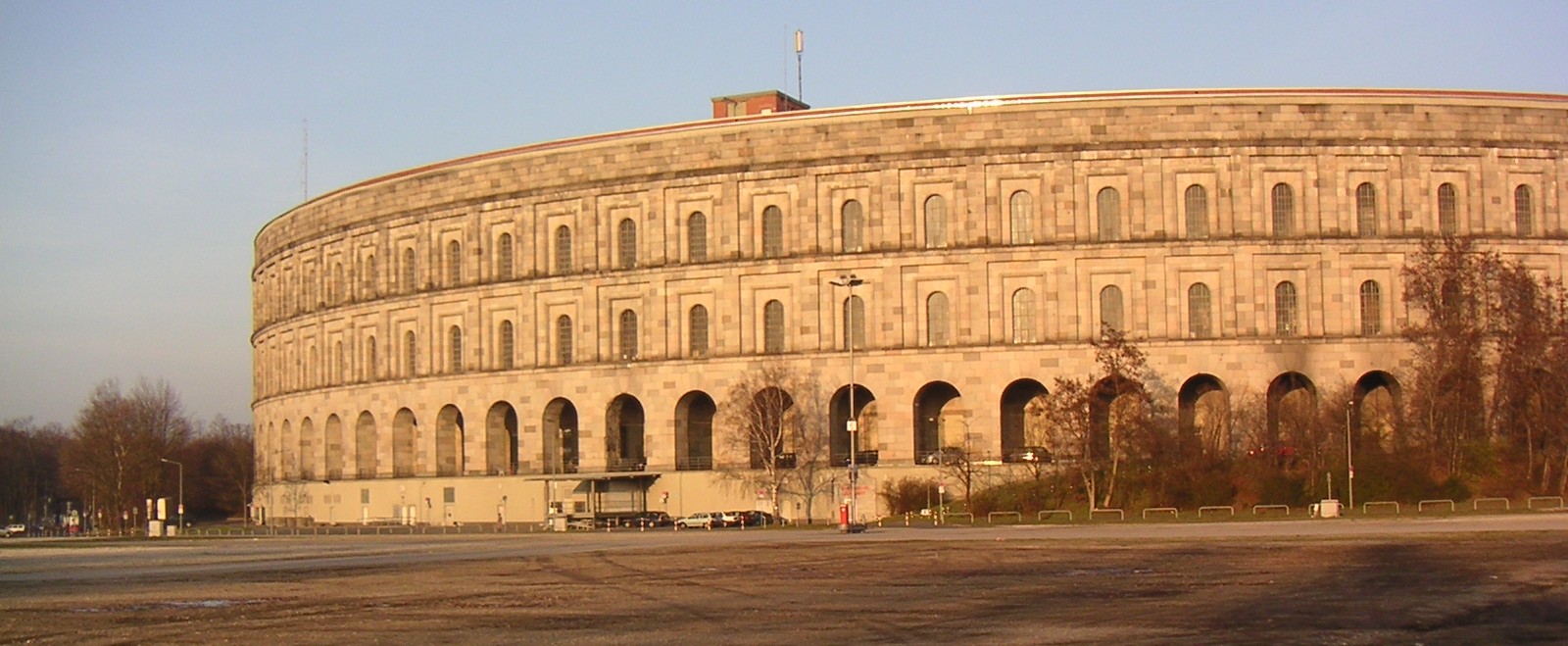
Nuremburg was also home to the Congress Hall or Kongresshalle, which although it was never completed, is the largest preserved monumental building from the Nazi period. It was designed by Ludwig and Franz Ruff and was to be a party congress centre with 50,000 seats. Begun in 1935, the exterior bears some resemblance to the Roman Colosseum.


(images via 1, 2)


Nazi Worker's Paradise: Seaside Resort and Spa

One of the biggest Nazi structures which still survives is the Prora resort and spa on the Baltic Island of Rugen, built between 1936 and 1939 (work ceased at the outbreak of war). A series of five seaside resorts were planned, to provide vacations for the average German worker, but the Rugen location was the only one that was actually started (more info):


(images via)

Like most of the other Nazi era projects, the scale was massive, involving some 9000 workers and every major construction company in Germany. The plan was to construct two complexes with four blocks of ten housing units in each one. There would be rooms for 20,000 people, each room with its own sea view and the resort would have extended for over five kilometers along the beach.


(images via)

There would also be buildings for administration, workers accommodation, large festival squares, assembly halls, huge swimming pools, restaurants, theatres, sports arenas, a large quay for mooring cruise ships, as well as a train station and all the infrastructure and utilities needed for such a massive undertaking. It never fulfilled its intended purpose and housed refugees from Hamburg and other cities towards the end of the war, as well as being utilized for military personnel and as a hospital.


(images via 1, 3)

Prora was briefly used by the Soviet army after the war, then by the East German military until the early nineties. The remains of the Prora complex are the largest Third Reich era building still in existence and debate continues as to whether the site should be preserved.


Exporting totalitarian architecture to the rest of the world

And finally, showcasing Nazi architecture was not limited to Germany. When the International Exposition Dedicated to Art and Technology in Modern Life was held in 1937 in Paris, the two most prominent pavilions were those belonging to Germany and the Soviet Union, which were located directly across from each other. With a height of 500 feet, the Nazi pavilion designed by Albert Speer, was topped with a tower displaying a gigantic swastika and eagle, symbols of National Socialism.


(images via 1, 2, 3)

Like the Zeppelinfield in Nuremburg, at night Speer used floodlights to illuminate the structure. The pavilion's purpose was to showcase German pride and the strength of Nazi Germany as a bulwark against Communism, symbolized by the Soviet pavilion directly opposite.

------

Simon Rose is the author of science fiction and fantasy novels for children, including The Alchemist's Portrait, The Sorcerer's Letterbox, The Clone Conspiracy, The Emerald Curse, The Heretic's Tomb and The Doomsday Mask. Details of his books, plus online readings, excerpts, reviews, reader, comments and of his services for writers may be found at www.simon-rose.com You may also visit his blog at http://simon-rose.blogspot.com

------------

CONTINUE TO THE
"STRANGE TOWERS OF THE THIRD REICH" ->


Also Read:
Communist Gothic: Architecture by Yakov Chernikhov
Retrofuture: Glorious Urbanism

Permanent Link......+StumbleUpon ...+Facebook
Category: Architecture,History

READ RECENT POSTS:


Fascinating Matchbook Art

Always Striking! Classic Matchbooks, Part One

Biscotti Bits
Mixed Links & Images

Incl. "Clumsy Heinz Automatons"


Never Give Up! Crazy Logistics, Part 12

Not safe, by any stretch of imagination

COMMENTS::

35 Comments:

Anonymous Anonymous said...

One of the best articles in the last few weeks.

___  
Anonymous Anonymous said...

This is why I visit your site everyday.

___  
Anonymous Anonymous said...

michael palin visited prora in his last bbc series, you just reminded me of the name. thanks!

___  
Anonymous Anonymous said...

superb article!

___  
Anonymous Rob De Witt said...

Thanks once again for a great post. The learned architectural comments highlight the decided similarities between Socialist and National Socialist art, and reinforce the insight that Nazism was in fact merely a heresy of Marxism.

A useful comparison would be to the neo-Imperialist architecture of the new 0bama displays, beginning with the faux-Roman structures at the Denver convention. Not much changes.

___  
Blogger Alejandro said...

I like your web since long time ago and this is a very interesting article.

___  
Anonymous Anonymous said...

Rob de Witt is another ignoramus who graduated at the Norris-Palin University of Political Science...

___  
Anonymous Valar said...

Great architecture! Beautiful and clasic!

___  
Anonymous Michael said...

I enjoyed reading / watching your article, especially as a German. I really appreciate your neutral description of German history, maybe better than some contemporary German historians do. This helps the younger people to get distance to things my generation never dealt with.
I don't forget history, but I live in present. Great contribution, thanks!

___  
Anonymous Anonymous said...

Great post!!! I like this site very much, it's very funny and informative. However, it's sad that such a great post just made the De Witt guy reinforce his wrong insights...

___  
Anonymous Gimble said...

like the first comment says, One of the best articles last weeks.

about the Prora Rugen, There are plans to make it into a youth hostel. A dutch architect -Kempe Thill- has won a recent (2007) competition about "what to do with the building"

here is the site:
http://www.atelierkempethill.com/0030.html

___  
Blogger Maggie said...

There remain huge debates as many classical buildings are still being pulled down as the unwanted "wrong kind of architecture" for a modern Germany.

The other invented architecture, Volk, has usually been assimilated, and the only alterations one usually sees is removal of various swastikas. Hitler's personal home, tea house, and other homes in the Volk style in Berchtesgaden on the Obersalzberg were destroyed during or immediately after the war. Most other buildings in this style were just reused and accepted.

I'd like to see another illustrated article on this invented architectural style.

Much of Prora has recently, (2008), been sold and condos seem to be in the structures future.

___  
Blogger Michael said...

Grotesquely imposing structures, dwarfing the pathetic human form...didn't Albert Speer also design the Hummer?

___  
Anonymous Rob De Witt said...

I'm happy to have given you all the opportunity to practice your condescension. I'm certain you have done sufficient research to refute my point, since you were proud enough of your opinions to post them anonymously ;-}.

___  
Anonymous ryan said...

I always wondered about Hitlers fascination of the Romans. He was obsessed with Nordic lore, but Roman architecture.
It was the naked men sculptures, had to be.

___  
Anonymous Anonymous said...

been visiting your blog for years. nice find.

___  
Anonymous Slow Joe Crow said...

Robert Hughes' "The Shock of the New" has a good discussion of totalitarian architecture, where he describes the pseudo-classical architecture as "totalitarian doric" and also observes that the buildings in the New York state government mall in Albany would like perfectly natural with hammer and sickle or swastika decorations.
On a related note, the Beijing Olympic structures seem like a modern version of this.

___  
Blogger Avi Abrams said...

Thank you guys for all the info, this is why we totally enjoy comments on DRB :)

___  
Blogger DesScorp said...

Just goes to show that bad regimes can make good art and impressive architecture. It was ironic that everytime we saw a new concrete-and-steel box go up in our town... a school, or an office building, and we'd deride it as "communist looking". And yet when you compare postwar architecture of the US and the USSR, the Soviets were the ones making beautiful, impressive buildings, while it was we who were making the plain, soulless glass boxes. East Germany promoted that kind of Phillip Johnson asthetic, but the Russians knew how to make an impressive building (though often constructed poorly). I'll take the magnificent Moscow State University main building anyday over soul-sucking boxes like the Seagram Building.

The best comment ever made about our numbing modern architecture of the postwar years was made by Tom Wolfe, when he looked at the rows of plain, glass and steel boxes of Manhattan and called it the "Rue De Regret".

___  
Blogger Avi Abrams said...

DesCorp - Moscow University Building perhaps needs an article in itself...

___  
Anonymous Anonymous said...

Lichterdom was - according to Speers son - one of the works he was most proud of.
Actually it was a solution to a funny problem: Four groups of the armed forces were to parade: Army, Navy, Airforce and the 'Desk-force'. The latter were not so fit for parading - out of practice and out of shape. To hide this is it was decided to make the parade at night! But the decorations were made for daylight use and Speer came up with the idea of the unusual use of searchlights. Between 1 and 200 were needed and this covered the entire German searchlight reserve. Hitler had to be asked and was delighted: Our enemies will never believe, that we use all our reserves - off course we do it.

___  
Anonymous Anonymous said...

The pic of the 1937 is amazing considering it's context and time. I'd not seen it before. Thank you.

If you've not done an article on it yet, it would be interesting to compare the architecture of the same time between the Soviet Union and the US (Germany could be included). As an example, Moscow State U's building is remarkably similar to what was happening in lower Manhattan (and Rockefeller Center).
http://www.panoramio.com/photo/13358802

Keep up the great work DRB.

___  
Anonymous Jim said...

Thanks for the very interesting and informative article.

Rob De Witt would have fit in & thrived in Germany as chief sophist at the time.

___  
Blogger History Cellar said...

This was a great detailed article. Thanks for the great work.

James
http://thehistorycellar.blogspot.com/

___  
Anonymous Anonymous said...

The architecture featured at my Youtube channel may interest you: www.youtube.com/luddite333

___  
Blogger Damien DeBarra said...

Wonderful piece. Thankyou. Have added outgoing links back to here from a piece on Blather which touches on this: http://www.blather.net/globaleyes/archives/2009/01/welcome_to_the_game.html

___  
Anonymous Anonymous said...

Nazi arquitechture is the most boring bad taste ever.Not even impressing. In fact, Hitler didn't like the Olimpic stadium because wasn't big enough...or it really was dull! Amazing Speer was so valued then. We'll demonstrates Hitler's sick mind.

___  
Anonymous Anonymous said...

I came to this site expecting some typical trivia / top 10 lists, but man, I was wrong. With thorough, interesting and well-researched articles like this, I wouldn't bother reading the contents of your site as a paper magazine. Peace.

___  
Anonymous Anonymous said...

DesScorp said...
"Just goes to show that bad regimes can make good art and impressive architecture."


Bad regimes?

If the Axis won WW2 and Russia won the cold war we'd be the 'bad' guys and the suppressed horrors committed by the Allies and capitalists would be propagated and exaggerated in the same way Hollywood treats the Holocaust.

History is written by the victors!!

All humans are capable of despicable brutality and angelic compassion, there is no good or evil people, good and evil are perceptions conditioned by society. Fear and stupidity is what turns men into monsters, the enlightened oppressed become the egoistic oppressors on a whim.

___  
Anonymous Javier said...

DRB has style.

___  
Blogger PeachyLogic said...

Thank a merciful God that Hitler expended such a mind-boggling amount of recources and these buildings. That was time, material, and manpower that did not go into the war effort.

___  
Anonymous Anonymous said...

There is a building here in Birmingham Alabama that was built in the 1920's that has two swaztikas on the steps out front. I was told before WWII it was an Indian symbol for luck. Still creeps me out though.

___  
Anonymous Anonymous said...

It is said that good architecture needs totalitairian regimes to be build.

I think a lot of these buildings are quite good as pieces of architecture but seem to be 'polluted' by the function they once had. If they were build in England no one ever would have have thought about demolishing them and they might have been examples of typical stripped-classicism as part of a counter-functionalist movement.

I hope enough of them survive till the time we have enough distance from the past to see them as things-in-themselves instead of symbols they once been though for. Just think about the Roman Colloseum. Financed by money from the plundering of Jerusalem it was the place where prisoners (mainly Christians) were to fight with lions and other wild animals. Nowadays nobody thinks about tearing it down because of the cruelty it was once meant for...

___  
Blogger Avi Abrams said...

Wonderful comment... thank you for this. I might agree on this saying about totalitarian regimes / architecture connection. But I would say "epic architecture", not necessarily "good architecture".

___  
Anonymous Anonymous said...

World Capital Germania
Human sculptures: GAY!!!!
(Himmler's taste, maybe)

___  

Post a Comment

<< Home


SF ART & BOOK REVIEWS:
Don't miss: The Ultimate Guide to SF&F Writers!
Fiction Reviews: Alastair Reynolds "Chasm City"
Short Fiction Reviews: Lovecraft's "At the Mountains of Madness" (with pics)
New Fiction Reviews: The Surreal Office

READ MORE RECENT POSTS:


Coffee Art & Style Extravaganza

Have your cup of coffee with a smile (and a vengeance)


Extraordinary Inventions: Victorian-Era Prank Machines

Electric shocks and mechanical goats fun


The Best of "Dark Roasted Blend" in 2011

Wonders upon Wonders!


Cool Vintage Actors, Part 1

Charming, adventurous, funny


The World's Worst (and Ugliest) Cars

Somebody shoot these wheeled abominations


Cute Vintage Ice Cream Trucks

"Often Licked, Never Beaten!"..


The Most Incredible Space Imagery

Blast off to distant galaxies!


Merry Christmas & Happy New 2012 Year from DRB!

A healthy helping of Seasonal Cheer


Spectacular 2012 Heavy Machinery Calendar

Higher, Bigger, Heavier!


The Other Space Race

Active Space Programs outside USA or Russia


Hilarious Prank Letters to Corporations

"I am a lover of all things clarinettal..."


American Concept Car Showcase, Part 2

The Age of Chrome, Aerodynamic Excess and Sheer Excitement


The World's Largest Ship Propellers

Steel behemoths propelling huge ships


Heavy Machinery in Trouble! (Wow Pics)

The heavier they are, the harder they crash


Surreal Art Update: Glass Garage Gallery

Not afraid of "pretty", but still pretty weird

FULL ARCHIVES (with previews, fast loading): 

Dec-Jan 2012 --
November 2011 -- October 2011 -- September 2011 -- August 2011 --
July 2011 -- June 2011 -- May 2011 -- April 2011 -- March 2011 --
February 2011 -- January 2011 -- December 2010 -- November 2010 --
  October 2010 -- September 2010 -- August 2010 - July 2010 --
June 2010 -- May 2010 -- April 2010 -- March 2010 -- Winter 2009-2010 --
October-November 2009 -- September 2009 -- August 2009 --
June-July 2009 -- May 2009 -- April 2009 -- March 2009 --
February 2009 -- January 2009 -- December 2008 --
November 2008 -- October 2008 -- September 2008
August 2008 -- July 2008 -- June 2008
May 2008 -- April 2008 -- March 2008
February 2008 -- January 2008 -- Dec, 2007
November 2007 -- October 2007 -- Sept, 2007
August 2007 -- July 2007 -- June 2007
May 2007 -- April 2007 -- March 2007
February 2007 -- January 2007 -- Dec, 2006
November 2006 -- October 2006 -- Link Lattes

...


CATEGORIES
airplanes | animals | architecture | art | auto | boats | books | cool ads | funny pics | famous | futurism | food
gadgets | health | history | humour | japan | internet | link latte | military | music | nature | photo | russia | steampunk
sci-fi & fantasy | signs | space | sports | technology | trains | travel | vintage | weird


Also read DRB on iPad:
Flipboard - Cool Curators


Airplanes
Animals
Architecture
Art
Auto
Boats
Computers
Cool Ads
Extreme Weather
Food
Funny Pics
Futurism
Gadgets
History
Humour
Link Latte
Military
Music
Nature
Oops Accidents
Photography
Robots
Science
Science Fiction

Space
Sports
Technology
Trains
Travel
UE Abandoned
Vintage
Weird


Avi Abrams
Rachel Abrams
M. Christian
Simon Rose
Paul Schilperoord
Scott Seegert
Constantine vonHoffman

- Join Our Team -
Guidelines


  • When I was a kid we had a foot length of that phone cable in a cupboard. It provided all the wire for my childhood experiments.
    Read more

  • The mechanical fractals are scary fascinating.
    Read more

  • The last one reminded me of those MC Escher prints. Imagine combining Escher & fractals- whoa!
    Read more

  • Great blog
    Read more

  • Talking aboute mechanical fractals: the Vasconcelos library in Mexico:

    picture
    Read more

  • these things hurt my brain. ow.
    Read more

  • Actually the first one in the Groovy Fractals by Professor Enigma set made me think of the inside of the Way from one of Greg Bear's "Eternity" books.
    Read more

  • I'm annoyed that the clearly superior side is labeled 'B' as thought it should come after 'A' in consideration. The janitor at my place of work also uses this obnoxious 'over the back' configuration, despite the many notes I have left him to rectify the situation.
    Read more

  • true. configuration A isn't just unergonomic but more complicated to use as well.
    considering that there are some TP-holding constructions with a lid on top to help in tearing individual pieces off, configuration A is clearly not the one to prefer.

    i would guess they are watchin a particulary painful stunt.

    the reason i'm thinking this is because i recognise the faces.
    on the left the half face belongs to "Steve-O", the doggy i dont know, the guy with the missing tooth is Ehren McGhehey, the one in the lower right is Dave England and the quarter face behind Dave is Loomis Fall.

    so i guess someone is breaking his own bones, slamming hard on the ground or doing some other pretty painful thing. =)
    Read more

  • I'm definitly a B-sider.

    the sheet is easier to find...AND you only touch the sheets you need.
    Read more

  • I prefer neither A nor B but instead to keep the roll off the holder altogether. Is that C or off the alphabet altogether?
    Read more

  • I never left a comment, but I f*ing love this site !!!!

    please continue !


    a french guy.
    Read more

  • B may appear more handy but usually when you try to tear the paper you either:

    a) rip apart the sheet, leaving fragments on the lid.

    b) doesn´t rip well, tube rolls and you end with more paper on your hands than you need.

    A is superior because it prevents unwanted rolling and it helps you to rip the sheet properly.
    Read more

  • This site is Awesome I havitsaved as a Favorte, and stuble acros it on my searc nd end up spendin hours Here !
    keep up the good work and don't use a wirelss keyboard as typos happen alot.
    the Wykeman
    Read more

  • If anybody knew anything about anything, they would surely see the vast difference in sanitary properties of each choice. B is superior. Be keeps the paper away from touching the wall ( which is of questionable cleanliness). If you need proof that B is superior, make note that in better hotels, the roll is in the B position, and the first sheet neatly folded into a point.

    The roll at all times should not touch any surface, so it stays sanitary. This would also insinuate, that any cat playtime with said roll would be a definite breach in sanitary condition....
    Read more

  • "note that in better hotels, the roll is in the B position"

    This is true, I worked at hotel and we had to place them in the B position. Most places I've worked which had public toilets also insist on the B position.

    You don't want to know what happens if you put it in a A position in a public toilet... Some people have no coordination when wiping their behind.
    Read more

  • Very cool - liked the time lapse of the Sun.
    Read more

  • Don't forget Jeff de Boer's amazing armor for cats and mice:
    http://www.darkroastedblend.com/2006/12/animal-armor-new-art-form.html?showComment=1167414420000
    Read more

  • I need a new mask...
    Read more

  • For the history minded, the longbow didn't do much against the French except goad them into a fight. The armor clad infantry were killed the old fashioned way: spears and clubs.
    Read more

  • true. it wasn't the longbows that killed them. the terrain played a huge part in that conflict. First, there was a bottleneck in the terrain, so the French knights weren't able to gain from their advantage in numbers. Second, the area became very muddy, thus, the armor not only slowed the knights down, but the sheer weight prevented those that went down/slipped from standing up. In contrast, the lightly armored Englishmen had better mobility and were able to cut down the (horribly) advancing French knights.
    Read more

  • "T'is but a flesh wound!"
    Read more

  • Henry VIII, eat your heart out.
    Read more

  • chain mail did not make a difference, they did not carry you off they battlefield on a stretcher in the middle agess. what a muppet.
    Read more

  • @anonymoous:
    >chain mail did not make a difference, they did not carry you off they battlefield on a stretcher in the middle agess. what a muppet.

    Of course. They just left their friends and brothers to die in the mud and the cold. Friendship and comraderie hadn't been invented yet, you know, in those days.
    /irony //just to be sure
    Read more

  • Excellent as always, Avi!

    For the next Funky Armours installment, don't forget Ned Kelly's infamous DIY plate armour...

    here's a link, complete with "inside the armour" video
    Read more

  • Just wanted to say wow, what a great article! I am a medieval buff but never looked at the history of armor.
    Can not wait to share this with my friends.


    Sari
    theviewfromsarisworld.blogspot.com
    Read more

  • There's nothing medieval at all about the first one with the face and eye-grills, and there are a large number of copies/fakes/fantasy in there but you've got lots of great originals too.
    Read more

  • But as weapons got more sophisticated during this Middle Ages arms race, smiths had to keep up, making their suits stronger, lighter, and more flexible until they'd reached the pinnacle of defense as well as offense

    Well, not so much. Suits got heavier as firearms came into popularity, until they were too heavy to be useful and still stop a bullet.

    (Thus "bullet proof", from being tested (proofed) by being shot, and successfully stopping the bullet.)

    Lighter armor is great against a thrusting weapon, assuming it can still stop it - but against a mass weapon or heavy impacts, heavier armor is more protective, as the mass of the armor will absorb impact.

    (This is observed by modern re-enactors; one can use titanium armor to reduce weight, but it doesn't absorb impact force very well.)
    Read more

  • Several photos here I've never seen before. I wasn't aware that Europeans ever created helmets made to emulate an actual face, but it seems they did. Interesting.
    Read more

  • If anyone is ever in NYC go to the metropolitan museum of art. they have an amazing collection of armor including full suits of armor for horses
    Read more

  • Early in the Hundred Year's War, longbows could easily take out a knight - provided he was within penetration range. At the beginning, this was anywhere from 50 to 200 yards, but towards the end of the war some armour became so heavy and strong that it was almost impossible to penetrate (aside from some weak sections such as the thin armour near the eye holes).

    The French knights got scrooged over mostly because they were riding horses which had nowhere near enough armour to protect them from an arrow, especially not the incredibly damaging broadhead arrows which longbowmen carried especially for killing horses.

    The horses would get hit, fall over. The knights, if they were lucky, would land safely and get on with the moving - but more often the knight would be hurt by the fall (he is in heavy, restrictive armour, after all).
    Read more

  • The longbow, it gets so much love that it seems many people have forgotten that the English actually LOST the 100 years war and that means the French WON the war. Unbelievable? believe it ;)
    Read more

  • What a great reference page, thanks for posting it!

    Meanwhile, Jesper is right - a longbowman could really mess up an armor'd knight's (er) day, regardless of terrain and weather.

    When folks such as Anon & raul talk about terrain acting as an advantage for longbowmen, they're usually thinking of Agincourt. True, the terrain at Agincourt was an undeniable advantage in that encounter, but it was by no means the only battle decided by longbows. Ask Harold of England in 1066... :)
    Read more

  • William the Conquerer did not use longbows and except for an arrow in Harolds Eye did not decide the outcome (he was wounded by the arrow but killed by Norman knights). The first major use of massed longbow fire was at the battle of Flakirk, which so impressed the English King with the slaughter of the lightly armoured scottish clansmen that they became a large section of every English Army ever since.

    There were nearly 10,000 English archers at Agincourt, if they each fired off 25 which is 1 quiver each thats a quarter of a million arrows.

    Around 10,000 French were killed. I group which is dedicated to the study and reenactment of this battle told me that more french drowned in the mud after wounds than were killed by arrows and that the English Infantry slaughtered the majority of the rest.

    Direct fire from Longbows is nasty but most english armies used showers of arrows which are much less effective against armor except against cavalry as it is almost impossible to give a horse the same protection as a man.
    Read more

  • Thank you for insightful comments, read with interest
    Read more

  • Am I the only on e who noticed that someone has written an article on ARMOUR and can't spell it.
    Read more

  • "Armor" is the Americal spelling. "Armour" is the British spelling.
    Read more

  • The French knights got scrooged over mostly because they were riding horses which had nowhere near enough armour to protect them from an arrow, especially not the incredibly damaging broadhead arrows which longbowmen carried especially for killing horses.
    Read more

  • Just take a look at the armor belonging to that spokesman for restraint and modesty, Henry the 8th: not only was it state-of-the-art for its day, but it was designed and built -- as was most armor of the day -- to the wearer's dimensions.
    Read more

  • Proper medieval armour cant be pierced by a bow in mortal areas (helmet or breastplate) maybe a lucky shot or a corssbow at CLOSE range would be able to pierce some weak spots of the armour. But thats it.

    Longbows and crossbows aren't half as strong as its said to be.
    Read more

  • samurai armor was very minimal compared to the armor of other cultures.
    Read more

  • Pause, don't hyperventilate: One of their brilliant innovations was perfecting mail ... and, no, I'm not talking about the 'rain nor sleet' variety. Rumored to have been first created by the Celts many centuries before...."

    Mail was around long before the Celts discovered blue paint. In the ancient Roman Army it was called "lorica hamata," and was worn during some periods in preference to the more-publicized "lorica segmentata."

    Mail originated in (pick one): 1.Middle East. 2. India. 3. China. There are many exampkles from all three.
    Read more

  • Maybe not such a rotten period of time. Slavery died out after the fall of the Roman Empire. No large standing armies. Maybe "high" culture is over-rated.
    Read more

  • You might have a point there. Times were rough, but maybe more sublime.
    Read more

  • Read more

  • What Lenin would think? He'd approve seeing as he himself had a Rolls Royce. Which proves that some will always be more equal than others.
    Read more

  • India had to be involed, inspred post as usual,
    Read more

  • Those were DUPLO blocks not LEGO but close
    Read more

  • There's a pic of a white gold plated Mercedes floating around google images...
    Read more

  • The writer is a buttnose for referring to the "ugliness" of that wooden car. It's always beautiful to see the realization of a person's vision, especially if you can appreciate it in its own right, instead of comparing it to something else.
    Read more

  • nice buddy...... it's an excellent collection of latest cars and i have got many of the my favourite cars wallpapers from ur site but as u know there is always room for the betterment as no body is cent percent perfect
    Read more

  • Hey, I'm the Paula Wirth mentioned above... Although I took the photo of the lego car, I am not the owner or artist of the car... but they must be very cool, indeed.
    Read more

  • This is fantastic!

    DRB has been my absolute favorite and most recommended site for quite some time, but this gem of a list has made my day, no, my month!

    Thanks for yet another amazing resource.

    There are many of us that cherish what you guys do here.
    Read more

  • Great stuff!

    The amount of work that's gone into this must be absolutely immense.

    Thanks for posting this and putting in the hours, now if you could get another one started on the world's classic novels, that would be great!
    ;)
    Read more

  • What an awesome labour of love.
    Read more

  • Absolutely marvellous!

    I've felt that I'm simply overwhelmed by the sheer amount of authors these days, and lately taken refuge among classic litterature. This little wonder might just help me on my way getting into contemporary stuff once again.
    Read more

  • Wow! Absolutely amazing.

    "epic" indeed
    Read more

  • Is there a way to actually download and edit this spreadsheet? I would love to have something like this for my own use.
    Read more

  • Thank you for encouragement, it's great to get some input.

    Enusan - this is a working copy for now, something that we will be perfecting, so it's not for wide distribution yet.

    Stay tuned for more sci-fi-delicious updates!
    Read more

  • You are my heroe(s).
    Really
    Read more

  • Great work !
    I was too lazy to search myself for new writers to discover.
    It seems you did the job for me, thanks a lot !
    Read more

  • The Robert Reed link goes to the Brady Bunch actor, not the writer.

    This is a great effort. Thanks Avi.
    Read more

  • A fantastic resource, I can only offer a hearty thank you to all involved in it's creation and say that is will be used an awful lot in our home

    Thanks
    Read more

  • This is a great list! Why don't you offer it as a download so everyone can keep his own notes or filter it to his liking?
    Read more

  • Awesome. Thank you.
    Read more

  • Pretty Awesome. Only problem I can see is I'll never have time for anything but reading. Good thing I have a pretty non-demanding job.
    Read more

  • This is incredible!

    Thank you so much for sharing it!
    Read more

  • Thank you guys, really appreciated.

    Also, if anyone wants to help out with writing fiction reviews on SF DRB site, let me know by email.

    Happy reading!
    Read more

  • Avi, you create what the Web should be about: "the increase and diffusion of knowledge and wisdom, and their delights, among all people."

    Right On, Man!
    Read more

  • I have to point out that I read my first Vance Aandhal story in F&SF in 1964 or 1965. If I recall correctly, it was "When Lilacs Last in the Dooryard Bloomed"(from a Whitman poem). He pretty much disappeared not long after that.
    Read more

  • Excellent guide, love the notes, discovered some new (for me) great authors.
    Read more

  • Thanks for sharing this great and very complete guide about writers in this variety of the sub-genres.

    Your effort is very remarkable. Thanks guys.
    Read more

  • This is by far the best writer's resource I've ever read thanks.
    Read more

  • Just came upon this amazing reference. It's bookmarked, and I'm sure I'm going to be visiting it often. What a terrific piece of work!
    Read more

  • I would love to see pics of the artists on scaffolding spray painting the Kelburn Castle.
    Read more

  • on the one hand, it's not right that they're doing this to historic structures like that... but on the other hand...it's freakin awesome!
    Read more

  • "painted over by Brazillian street artists from Sao Paolo, Nina and Nunca Os Gemeos (completed in June 2007)"

    Minor correction here...Nunca and Os Gemeos are 3 different people, Gemeos just always paint as a pair. Awesome story though..might have missed this otherwise
    Read more

  • Great artist with beautiful art castles.
    Read more

  • from stately castle to garbage in a few easy steps
    Read more

  • And the Brazilian town is "São Paulo", or, if you may, "Sao Paulo". Paolo is an Italian name, not Portuguese.

    Take care!
    Read more

  • Very nice castles turned to colourful piece of sh..t !
    Read more

  • Stone monolith > Tremendous work of human creativity? I don't think so
    Read more

  • A much more "Authentic" experience would include having the street "Artists" SHOOT at any disapproving spectators! Looks great now, but the paint will probably wash off soon, in that rainy Scottish weather!
    Read more

  • OMG, that's tragic. Surely there was an abandoned strip mall or another already worthless bit of property they could have destroyed instead.
    Read more

  • The paintings looks great but historic buildings shouldnt be used for such.
    Read more

  • reminds me of a castle i visited in portugal.
    Read more

  • really stupid. hey - lets go graffitti up the pyramids, or the taj mahal, or other historical buildings, monuments.
    And I am saying this as an artist.
    I so agree with Zajac - it is a colorful piece of &&&&**^
    Historical places should not be 'raped' by such things. Historical places should be preserved and treasured.
    Graffiti should be left for the bus terminals, abandoned buildings, or designated fences and other projects, where it doesn't ruin the landscape and cover up beauty.
    Read more

  • The "Mystery experiment" appears to be an archer attempting to shoot a balloon held in the mouth of the volunteer. In the photo, he appears to have aimed a little high, and just missed
    Read more

  • The picture of the orange soap opera seems to originate from http://weem.deviantart.com/art/Malaise-de-L-Orange-15973382
    Read more

  • The fruit infidelity pics are from
    'Malaise de L'Orange', here.
    Read more

  • Mystery Photo:
    President Barrack Obama being hazed his first week in office.
    Read more

  • Is it just me, or does the experimental subject resemble the President? Perhaps it was a special transition toughening exercise?
    Read more

  • A caption for that archery photo could be "Dude, you almost shot Brad Pitt".
    Cause for some reason it looks like him.
    Read more

  • It´s really fantastic. Very, very nice.
    Read more

  • Lovely stuff. I must try it myself.

    I think you'll find the "riveted, highly evocative face" is actually spot welded.

    Smerky
    Read more

  • Behold the Beaviance!

    Recently posted on Dr. Grordbort's Rayguns Fan Art Forum:

    http://www.wetanz-forums.com/viewtopic.php?t=1370

    March march march Zzzap!
    Read more

  • Great Series!

    But no serious round of contemporary retro robots would be complete without the work of Clayton Bailey. He's been making these for 35 years!

    http://www.claytonbailey.com/index.htm
    Read more

  • this reminds me of the movie Micmacs à tire-larigot
    Read more

  • Is this a book? If so I would love to purchase it. It is exactly what I was looking for for my 8 year old son. He has a big pile of metal and found objects in the garage. I wanted to give him a visual book for his b-day to inspire his creavtivity.If anyoe has any good ideas I would love to hear. Yvette
    Read more


Send us your topic ideas, site suggestions, rants or sweet unpublished poetry. We love to hear from you.


Misc.:
Custom t-shirts
China Tours


.