
"QUANTUM SHOT" #672 Link - article by Simon Rose and Avi Abrams
The art of glorious (or frightening) "hood ornaments" for ships
The elaborate decorative wooden carvings known as figureheads were found on the prow of ships built between the sixteenth and nineteenth centuries. Many depicted human females or animals, but other designs could be found as well. There had been ornamentation on boats and ships in earlier eras, in Egypt for example, plus in other cultures of the ancient world.
(top: the figurehead of the Cutty Sark, 1869; photo by Alexey Suloev, see more)
This ship’s figurehead was originally dated to the Viking period, but is now thought to be from between 350 and 650 AD, when the Germanic peoples were expanding in Europe during the breakup of the Western Roman Empire (left image below):
A few centuries later, Viking ships often displayed fearsome dragon’s heads on their voyages between around 800 and 1000 AD (middle and right images above).
However, the general practice of using a figurehead arrived with the development of the ocean going galleons of the 1500’s. Similar to the manner in which pub signs (which we examined in a couple of previous articles here on Dark Roasted Blend) were employed to advertise premises when the majority of the population couldn’t read, ship figureheads were often used to indicate the name of a ship in a much less literate society. They also could serve to display the wealth and social status of the ship’s owner or the might and power of the country, in the case of military vessels.
Various Dutch and Russian figureheads from 1739-1741:
Figureheads also served as a kind of good luck charm for the ship’s crew. In Germany, Belgium and Holland, it was believed that the ship’s figureheads contained spirits called Kaboutermannekes. These spirits protected the ship and crew from fierce storms, treacherous winds, uncharted rocks, illness or disease, and in the event the ship sank, the spirits would guide the sailors souls to the afterlife. If sailors lost their lives at sea without such protection, it was believed their souls would haunt the sea for all eternity.
Figureheads became somewhat popular again following the Napoleonic Wars, after having almost disappeared entirely by 1800, but were smaller that the full figure versions that had been popular in previous centuries.
Here’s the bow of Nelson’s flagship, HMS Victory, from the early nineteenth century (left).
The clippers, which sailed the globe’s trade routes in the mid nineteenth century, usually had full figureheads, but these were usually lightweight versions. Prior to being closed for major restoration, the tea clipper Cutty Sark at Greenwich, London, contained a large collection of ships' figureheads:
(all images copyright WhipperSnapper, used by permission)
The first steamships sometimes had decorations on their bows, but figureheads mostly died out with the demise of the sailing ship.
The Royal Navy ship HMS Rodney, launched in 1884, was the last British battleship to have a figurehead, although some smaller British vessels continued to use them until the early years of the twentieth century. Here’s the figurehead of HMS Warrior from the same era (left image):
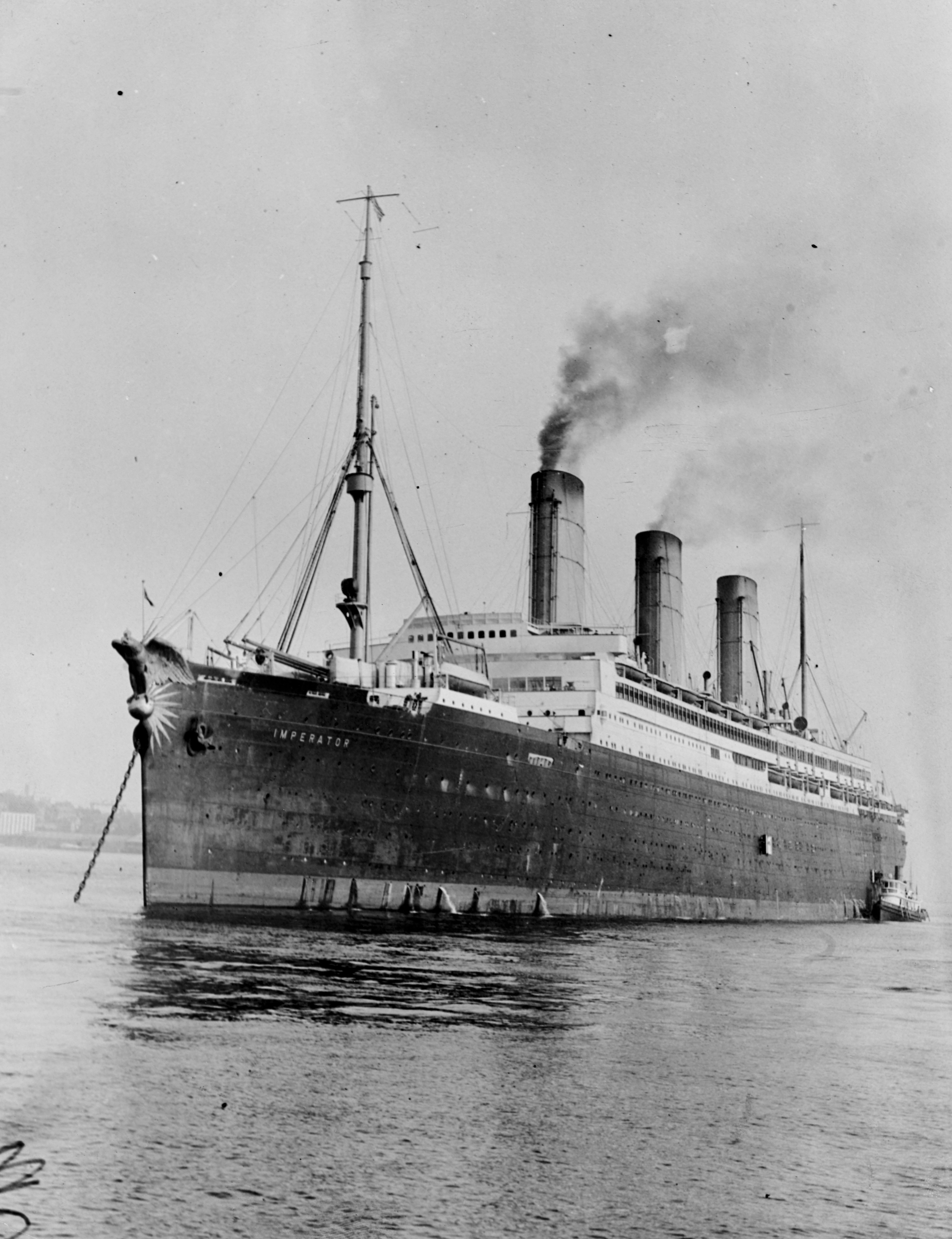
The German ocean liner Imperator, launched in 1912, used a large bronze eagle as a figurehead (see above image on the right). The extra feet of length it provided made Imperator the longest ship in the world at the time, beating the British ship Olympic, a sister vessel of the Titanic.
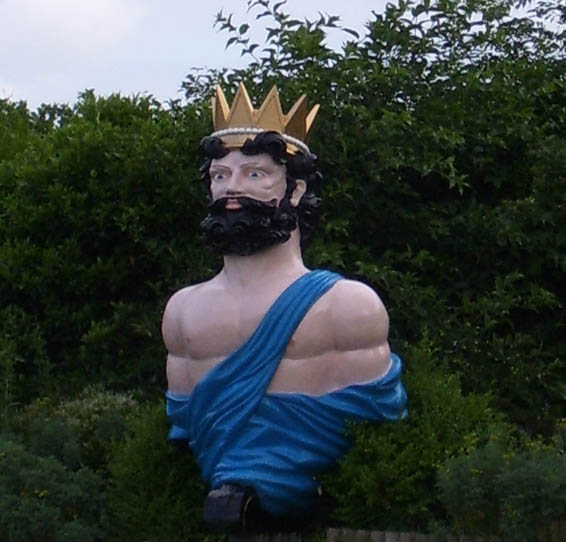
Figureheads usually depicted human figures, but here we have a lion (below left)... and even King Neptune himself (middle image), whose face seems entirely similar to the figurehead of HMS Ajax, which was built in 1809 and featured in many engagements during the lengthy conflict with Napoleon (below right):
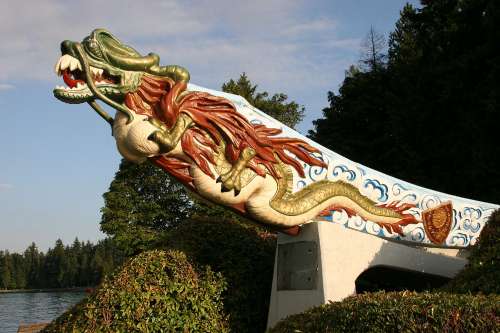
Here’s a sight familiar to residents of, and visitors to, the Canadian city of Vancouver. This carving of a sea dragon, located in Stanley Park, is a replica of the figurehead of the Empress of Japan, which sailed back and forth from Canada’s west coast to Asia from the early 1890’s until 1922.
And speaking of Asia, here are some examples of figureheads from Thailand, displayed on barges used by the royal family. This first one dates from the mid-sixteenth century.
Today, the examples of elaborately decorated figureheads found in museums, historic collections and other locations around the world remain a fascinating reminder of a bygone age. We hope you’ve enjoyed this look at figureheads here at Dark Roasted Blend.
This is another interesting figurehead of Thailand's barge. http://www.vcharkarn.com/uploads/35/35282.jpg http://www.shutterphoto.com/spbook/sp12_16/sp_july06_jpg/sp_12.jpg
Roman Polanski's "Pirates" ship is moored in Genoa's harbour, Italy: http://www.modellismo.net/forum/storia-e-personaggi-navali/71039-galeone-pirata-di-genova.html
Re:Would you go to Mars... with no return? It's no surprise to me that there would be no shortage of volunteers for a one way ticket to settle Mars. The urge to spread and proliferate is a primary biological mandate, as well as a quintessential factor of Human Nature and especially the American Character. Settling Mars would be a grueling, toxic endeavor involving enclosed arcologies and Dune-like moisture conservation. Far worse than the daily routine of distilling your own pee for lack of water is the immutable fact that Mars lacks a magnetosphere. It can never be terraformed as we used to hope, because it can never enjoy the protection from cosmic rays and solar bombardment that makes life on Earth possible. If complex life-forms ever existed on Mars, they were surely doomed by the time the tiny planet's core cooled and stopped generating its vital magnetic shield. But, Life Finds a Way. As soon as Earth evolved a life-form complex enough to spread to Mars and create it's own portable ecosystem there, colonization became a survival imperative. Living on Mars will always be like living on a space station-- a maddening tincan existence-- but if we survive long enough to do it, there will always be volunteers.
The NIN picture is of their Lighting Dimming system, not anything to do with the sound system ("sound console"). The DMX cable provides the control signal, the dimmers translate that control into power for each light/circuit.
That is actually lacing tape, a waxed cotton ribbon used for wiring harnesses. It is still used in modern aviation due to it being less bulky than zipties and it will not chafe the wire insulation. Also rubber definitely would have been allowed to be used since these machines were critical to the war effort.
Lacing tape @ wiki http://en.wikipedia.org/wiki/Cable_lacing
I am a lighting designer and the NIN picture has nothing to do with sound! Those are lighting dimmers and 5 pin DMX is a control protocol for theatrical lighting.
great compilaation, I remember once Prince Phillip the husband of the queen, visiting a factory seeing a messed up wiring and claimimg that the place look like it was built by an Indian. That caused a storm
This is awesome! I clicked on it because I thought it said "fantastically intense writing," but this is better. I really love this kind of quirky imagery.
kopapaka / www.palba.cz quote: "Blogger Francesca said... The blimp picture collage includes a blimp with the Nazi swastika on it...surely that's not in New York?" http://en.wikipedia.org/wiki/LZ_129_Hindenburg
About the Blimp with a Nazi Swastika. The Hindenburg was a German airship after all. The Nazis were in power for several years before the war started and regular trade did take place so it's not too surprising to see a Swastika on a blimp.
The Hotel Edison is still standing and seems to have been spiffed up in recent years. Also, a few of the black & white photos are by Samuel Gottscho. The Museum of the City of New York has many more in its digital collection. I just showcased a bunch of them on my blog - http://bit.ly/eqt5fk
2 Comments:
This is another interesting figurehead of Thailand's barge.
http://www.vcharkarn.com/uploads/35/35282.jpg
http://www.shutterphoto.com/spbook/sp12_16/sp_july06_jpg/sp_12.jpg
Roman Polanski's "Pirates" ship is moored in Genoa's harbour, Italy: http://www.modellismo.net/forum/storia-e-personaggi-navali/71039-galeone-pirata-di-genova.html
Post a Comment
<< Home