






























Quick Search of DRB:
Lijit Search
drb rss about
suggest
advertise
subscribe
rss rss
rss
airplanes | animals | architecture | art | auto | boats | famous | cool ads | funny pics | food | futurism | gadgets | history | japan
military | music | nature | photo | russia | sci-fi | signs | space | sports | steampunk | technology | trains | travel | vintage | weird


Hansen's Writing Ball & Other Unusual Typewriters


"QUANTUM SHOT" #656
Link - article by M. Christian and A. Abrams


Beautiful Typewriters From 'The Good Old Days'

Horse and buggies, hoop skirts, steam engines, bustles ... oh, yes, life around the turn of the previous century was a delight of simplicity and workmanship. But that doesn't mean that the artisans and engineers of way-back-when didn’t at least have their hearts and minds in the right place.


(images via The Typewriter Museum)

Take, for example, what writing used to be like before a few very bright bulbs thought to create machines to make it easier: pens that constantly ran dry, ink that spilled or smeared, illegible handwriting ... getting the message across -- any message across -- by hand was problematic at best, totally confusing at worst.

Linear Index Typewriters and "Typewritors"

One of the earliest of those bright bulbs was William Austin Burt who, in 1829, created what he called a 'typewritor.' If Burt's machine was, in fact, the first is a matter of much debate - as another, similar, machine had also been built by Pellegrino Turri around the same time. Some even say the crown of 'first' should go to Henry Mill, who created a writing machine way back in 1714.

All of these devices represented just baby steps: more potential than actual ability to help with clear, concise and fast writing. There were a lot of others after these early pioneers, but none of them were ever a real commercial success. Looking at them you can see why: in many of these very early models – called 'index typewriters,' by the way – the typing was done by selecting the letter to be used on a slider and then pressing it against the paper. To call these early monsters 'slow' is being kind. Changing the alphabetical slider to a disc version helped a bit but not enough to make any of these machines easy or popular.

Here is a "Linear Typewriter": one look at this machine and you can see why it was never a big hit. Just think about transcribing anything on this beast:


(images via Office Museum)

The 1890 Victor: "Take a letter, Miss Jones."


(images via Office Museum)


The Writing Ball That Will Warp and Enchant Your Mind

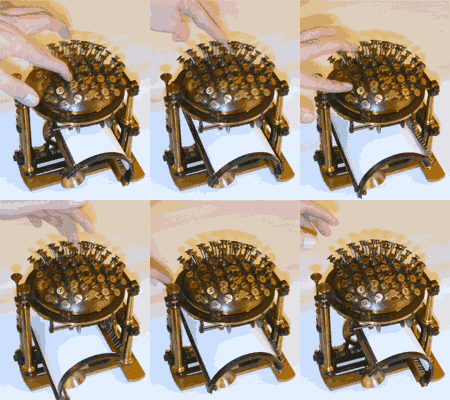
In 1865 what many consider to be the true ancestor to true, efficient, and financially successful typewriter was developed by Rasmus Malling-Hansen: The Writing Ball. Not only was it efficient, but also strangely elegant, even beautiful: just look at it - a brass half-sphere covered with keys above a cylinder that held the paper. It was finely made, unlike some of the unsuccessful machines before, looking more like a gentleman's watch than a piece of office equipment:


(image credit: Auction Team Koln, via)

The Malling-Hansen Writing Ball: not only one of the first commercial typewriters but also one of the most elegant (more pics and auction price info):


(images credit: Auction Team Koln, via The Malling-Hansen Society)

The Beauty of the Ball - It may have been difficult to use but it sure looked good on your desk:


(image credit: Auction Team Koln, via)

An Illustration of the Malling-Hansen Writing Ball: a lovely etching of the typewriter ball by Hans Gerhard Blodorn - buy a copy here


(image credit: Hans Gerhard Blodorn)

More pretty pictures of Hansen's lovely creation at The Typewriter Museum:


(images credit: The Typewriter Museum)

Sure, Hansen's Ball had some rather serious flaws – like the fact that it was hardly cheap and, because of the position of the ball and the paper under it, the typist really couldn't see what they were typing until they were done and the paper was removed from the machine -- but that didn't stop it from selling better than many other previous models. One quirk of the ball was that, unlike the QWERTY keyboard that pretty much every typewriter after it had and every computer now has, the ball's keys had been positioned to make typing easier for the typist and not the typewriter.

The Sad, Strange Story of QWERTY

By the way, in case you don't know the sad, strange story of QWERTY – which haunts us to this day -- the alphabet were originally put in that order because otherwise users would type faster than the machine could handle, thus jamming the keys. So QWERTY was created to keep that from happening: to keep the machine happy at the cost of typist efficiency.

Here's a fun bit of trivia for you folks now interested in Malling-Hansen's elegant writing ball: one particular person was interested in this new, wondrous invention – a celebrated writer who was having a hard time with his diminishing eyesight. While Nietzsche did get and use his writing ball he sadly didn't love it – though it is fascinating to visualize the author of Thus Spoke Zarathustra clicking and clacking on the mechanical beauty of one of Hansen's creations.


Balls Of Every Shape And Size

Hansen didn't stop with his first creation. Over the years after the release of his first ball he created a whole range of machines with all kinds of variations:

A handsome selection of Malling-Hansen Writing Balls, including a lovely one in a wooden case can be found at The Malling-Hansen Society -


The Miniature Writing Ball (more info and pictures here):


(images via)

The cryptographic writing ball by Alexis Kohls, circa 1883 -


Another fascinating keyboard variation: The Piano-style Keyboard - American-made Hammond from 1880:


(image via)

Eventually, though, other – and cheaper – machines were developed, saving generations of writers, secretaries, business people, and anyone else who used to have to put pen to paper, from cramp and bad handwriting. Though Hansen and his elegant ball have been almost lost to time it's nice to be able to show a new, QWERTY-slaved generation, the beauty of his creation.


CONTINUE TO "CURTA MECHANICAL CALCULATORS"! ->

Share

READ RECENT POSTS:


Topological Marvel: The Klein Bottle in Art

Impossible shape with no distinct "inside" or "outside"

Biscotti Bits
Mixed Links & Images

Incl. "Hypnotic: Mechanical Principles"


The Cutest Animals: Awww Update

In our tough world we need a shot of cuteness...


"Dark Roasted Blend" - All Kinds of Weird and Wonderful Things, Discovered Daily!"

DRB is a top-ranked and respected source for the best in art, travel and fascinating technology, with a highly visual presentation. Our in-depth articles in many categories make DRB a highly visual online magazine, bringing you quality entertainment every time you open your "feed" reader or visit our site.

Connect with us and become part of DRB on Facebook, Twitter, Pinterest, Google Plus; make sure to subscribe to our updates.

Our mobile site: http://mobile.darkroastedblend.com. You can also read us on iPad, as part of Flipboard popular free app, under "Cool Curators" category - see here.


COMMENTS::

8 Comments:

Blogger Angela Atkinson said...

Seriously love this post! So much that I tweeted it and shared it on FB. Thanks! :)

___  
Anonymous Exit32b said...

Back in my day we used type writers, not new fangeled computers to do our typin.

___  
Blogger Sigivald said...

The problem with "QWERTY slows you down to help the typewriter" is that... it doesn't slow typists down.

There appears to be no decent evidence that there is any keyboard layout that is significantly better for fast typing.

(This is not because the QWERTY layout is especially good, but because speed is far, far more dependent on training than on the keyboard layout.

You'd have to deliberately design a layout to be slow to get much slowdown, given an identical amount of typing training between test subjects.)

___  
OpenID jadeluxe said...

There is in fact a keyboard layout that enables significantly faster speeds - the stenography keyboard:

http://s228.photobucket.com/albums/ee107/jadekf/?action=view&current=Good_Keyboard.jpg

It's a lot more specialised (and takes a hell of a lot longer to learn to operate) than the QWERTY layout; but the standard operating speed is 250wpm.

It's the machine used for realtime court reporting and most live captioning.

___  
Anonymous Wojciech Kruzel said...

Please note that QWERTY has been possibly designed that way to help sale the typewriters.
When you type TYPEWRITER, you use only the top row of letters, and that was supposedly helping salesmen to sell them: "Look, let's type something! Let's type TYPEWRITER! See, how fast and easy it is?" - could be a very commonly used phrase by tradesmen.

___  
Anonymous chuckg said...

Actually, the QWERTY layout was designed, or intended, to put consecutively typed characters far apart on the little levers, so they wouldn't whack into one another. Anyone who has ever used a mechanical typewriter knows that can happen.

___  
Anonymous Nemo -- N'rn WI said...

"""
...otherwise users would type faster than the machine could handle, thus jamming the keys. So QWERTY was created to keep that from happening: to keep the machine happy....
"""

Alright, let's assume this argument is true. The conclusion, "...at the cost of typist efficiency." is still wrong... It is WAY more efficient to type slowly and carefully than it is to have to stop and un-jam the keys every few seconds.

___  
Anonymous Acrylic nails said...

Your post is incredible, can’t wait for more updates

___  

Post a Comment

<< Home


SF ART & BOOK REVIEWS:
Don't miss: The Ultimate Guide to NEW SF&F Writers!
Fiction Reviews: Classic Cyberpunk: Extreme Fiction
Short Fiction Reviews: Lovecraft's "At the Mountains of Madness" (with pics)
New Fiction Reviews: The Surreal Office


READ MORE RECENT POSTS:


Glory of Early Aviation (1930s-1960s)

Vintage Air Travel Posters and Airline Nostalgia


Sleek Vintage Salon Hair Dryers

Chrome Coolness, Gentle Breeze and Space Age Fashion


Awesome Armoured Trains and Rail Cruisers

Great symbols of power and "stable stagnation"


Strange Deep-Sea Diving Suits

Under Pressure... and Enjoying It


The Golden Age of Cigar Box Art

Elaborate Old Cigar Boxes: Visual & Historical Treat


Thrill Ride: Bumper Cars

Wonderful vintage & adapted bumper cars


Futuristic Aircraft Update

Inspiring, radical designs...


Strange Eye Exam Charts

Offbeat Optometry: Testing, Testing...


Drinking of Absinthe: Dancing with the Green Fairy

The Bohemian Realm of Absinthiana


The Last Victorian Leviathan Steam Ship

The "Great Eastern", one of the most spectacular ships ever built!


World's Strangest Vehicles, Part 1

The Very Opposite of "Soccer-Mom Minivans"


Some of the Biggest Spills & Accidents

"Experience is simply the name we give our mistakes."


Fictional Currency & Imaginary Money

Money that’s literally out of this world


The Ghosts of Antarctica: Abandoned Stations & Huts

Entering "The Thing" and "The Mountains of Madness" territory...

FULL ARCHIVES (with previews, fast loading):

April 2013 --
March 2013 -- February 2013 -- Dec-Jan 2013 --
November 2012 -- October 2012 -- September 2012 --
August 2012 -- July 2012 -- June 2012 -- May 2012 -- April 2012 --
March 2012 -- February 2012 -- Dec-Jan 2012 --
November 2011 -- October 2011 -- September 2011 --
August 2011 -- July 2011 -- June 2011 --
May 2011 -- April 2011 -- March 2011 --
February 2011 -- January 2011 -- December 2010 --
November 2010 -- October 2010 -- September 2010 --
August 2010 - July 2010 -- June 2010 --
May 2010 -- April 2010 -- March 2010 --
Winter 2009-2010 -- Oct-Nov 2009 -- September 2009 --
August 2009 -- June-July 2009 -- May 2009 --
April 2009 -- March 2009 -- February 2009 --
January 2009 -- December 2008 -- November 2008 --
October 2008 -- September 2008 -- August 2008 --
July 2008 -- June 2008 -- May 2008 --
April 2008 -- March 2008 -- February 2008 --
January 2008 -- Dec, 2007 -- November 2007 --
October 2007 -- September 2007 -- August 2007 --
July 2007 -- June 2007 -- May 2007 --
April 2007 -- March 2007 -- February 2007 --
January 2007 -- December 2006 -- November 2006 --
October 2006 -- Link Latte Issues -- Biscotti Issues

...


CATEGORIES:
airplanes | animals | architecture | art | auto | boats | books | cool ads | funny pics | famous | futurism | food
gadgets | health | history | humour | japan | internet | link latte | military | music | nature | photo | russia | steampunk
sci-fi & fantasy | signs | space | sports | technology | trains | travel | vintage | weird


Go to Mobile Site Version
Also read DRB on iPad:
Flipboard - Cool Curators


Airplanes
Animals
Architecture
Art
Auto
Boats
Computers
Cool Ads
Extreme Weather
Food
Funny Pics
Futurism
Gadgets
History
Humour
Link Latte
Military
Music
Nature
Oops Accidents
Photography
Robots
Science
Science Fiction

Space
Sports
Technology
Trains
Travel
UE Abandoned
Vintage
Weird


Avi Abrams
Rachel Abrams
M. Christian
Simon Rose
Paul Schilperoord
Scott Seegert
Constantine vonHoffman

- Join Our Team -
Click for Guidelines

Send us your topic ideas, site suggestions, rants or sweet unpublished poetry. We love to hear from you.