 "QUANTUM SHOT" #654 "QUANTUM SHOT" #654
Link
- article by M. Christian and
A. Abrams
Passive-Aggressive, Green and Very Hungry!
You have to admit, it does make a kind of twisted sense: After all, we've
been feasting on their fibrous, nutrition-packed stems, leaves, tubers,
and fruits since we began to actually eat the salad that came with our
steaks so, naturally, there must have been a certain ... well, 'desire'
for reciprocity. In other words if we eat them why shouldn't they want to
eat us?

 (images
via)
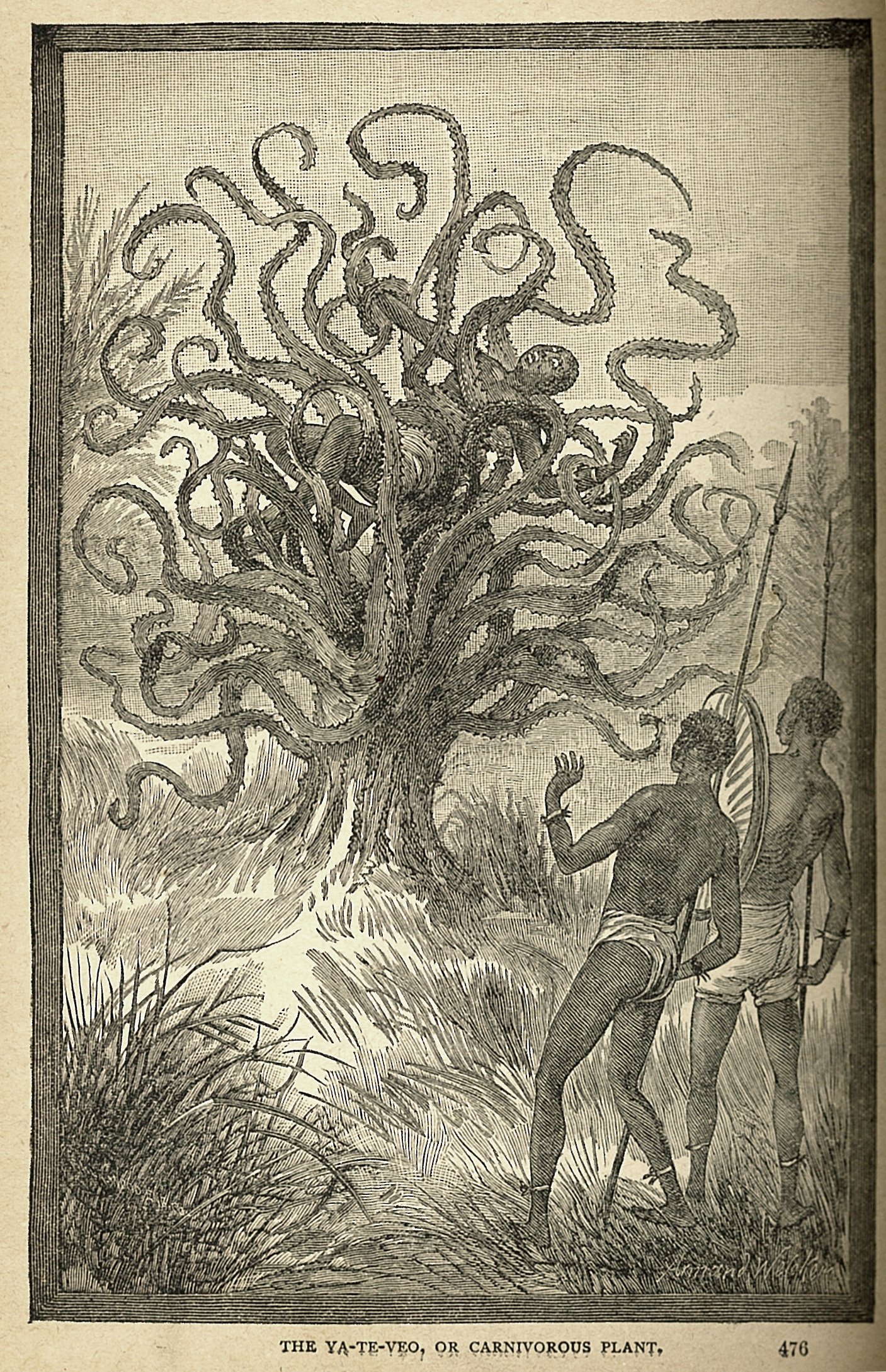
For all you geeks out there – and, yes, we know who you are – it's
commonly thought that the first depiction of a salad making a meal out of
a man comes from Dr. Carl Liche, writing in 1881. J.W. Buel echoed the
idea in his Land and Sea in 1887 (see below). Unluckily for Liche and Buel
they've been since exposed as 'imaginative' instead of 'accurate.' ("The
Day of the Triffids" by John Wyndham also deserves a mention). Hate to
disappoint but true man-eating plants are a total myth:
(images
via)
For all you geeks out there – and, yes, we know who you are – it's
commonly thought that the first depiction of a salad making a meal out of
a man comes from Dr. Carl Liche, writing in 1881. J.W. Buel echoed the
idea in his Land and Sea in 1887 (see below). Unluckily for Liche and Buel
they've been since exposed as 'imaginative' instead of 'accurate.' ("The
Day of the Triffids" by John Wyndham also deserves a mention). Hate to
disappoint but true man-eating plants are a total myth:
 (image
via, click to enlarge)
But that doesn't mean that the next time you sit down to feast on a
supposedly defenseless potato there aren't other forms of plant life that
are also having a tasty meal of, while not us humans, then most definitely
other animals – and sometimes rather large animals.
(image
via, click to enlarge)
But that doesn't mean that the next time you sit down to feast on a
supposedly defenseless potato there aren't other forms of plant life that
are also having a tasty meal of, while not us humans, then most definitely
other animals – and sometimes rather large animals.
 (images credit:
Barry Rice,
2)
Venus Entrapment
The poster-plant for botanical carnivores has got to be the legendary
Venus Flytrap. A resident of swamps and bogs, the flytrap has
evolved a dramatic solution to its lack-of-nutrient diet: it catches flies
– and pretty much anything big enough to get caught.
(images credit:
Barry Rice,
2)
Venus Entrapment
The poster-plant for botanical carnivores has got to be the legendary
Venus Flytrap. A resident of swamps and bogs, the flytrap has
evolved a dramatic solution to its lack-of-nutrient diet: it catches flies
– and pretty much anything big enough to get caught.
 (left via;
right image credit:
Karoshi)
What's amazing about this plant is its mechanism. Anything that happens to
stumble between the two halves of its unique mechanism will find itself in
caught in a quickly-snapping-shut botanical bear trap. What's even worse
is that after being caught the Venus then fuses those leaves together,
turning them into a kind of stomach to digest its prey. What's
extra-fascinating is that the trap has two triggers, and that both of them
have to be tripped for the leaves to snap shut, to avoid misfires.
(left via;
right image credit:
Karoshi)
What's amazing about this plant is its mechanism. Anything that happens to
stumble between the two halves of its unique mechanism will find itself in
caught in a quickly-snapping-shut botanical bear trap. What's even worse
is that after being caught the Venus then fuses those leaves together,
turning them into a kind of stomach to digest its prey. What's
extra-fascinating is that the trap has two triggers, and that both of them
have to be tripped for the leaves to snap shut, to avoid misfires.
 (image via)
Alluring Perfume in a Deadly Pitcher
While the flytrap looks like something out of a monster movie it rarely
grows to any really impressive size – unless you happen to be a housefly.
But one carnivorous plant that really is impressive, and recently
discovered, is what's called a passive hunter. Instead of using snapping
traps its family instead has evolved fluid-filled pitfalls lined with very
slippery sides, and baited with a very alluring perfume.
(image via)
Alluring Perfume in a Deadly Pitcher
While the flytrap looks like something out of a monster movie it rarely
grows to any really impressive size – unless you happen to be a housefly.
But one carnivorous plant that really is impressive, and recently
discovered, is what's called a passive hunter. Instead of using snapping
traps its family instead has evolved fluid-filled pitfalls lined with very
slippery sides, and baited with a very alluring perfume.
 (right: Sarracenia hybrid - images credit:
Helene Schmitz, National Geographic)
Pitcher plants come in a wide variety of shapes, types, and sizes –
including a special one native to the Philippines. Most pitchers feast on
bugs and sometimes small lizards: pretty much whatever's unfortunate
enough to get seduced by the plant's alluring smells and is small enough
to fit down its leafy throat. While its mechanism is similar to its
smaller kin, nepenthes attenboroughii (named after journalist and TV
presenter David Attenborough), has traps that are large enough to catch
not only bugs, lizards, and – what's more than a bit scary – rats (more
info).
(right: Sarracenia hybrid - images credit:
Helene Schmitz, National Geographic)
Pitcher plants come in a wide variety of shapes, types, and sizes –
including a special one native to the Philippines. Most pitchers feast on
bugs and sometimes small lizards: pretty much whatever's unfortunate
enough to get seduced by the plant's alluring smells and is small enough
to fit down its leafy throat. While its mechanism is similar to its
smaller kin, nepenthes attenboroughii (named after journalist and TV
presenter David Attenborough), has traps that are large enough to catch
not only bugs, lizards, and – what's more than a bit scary – rats (more
info).
 (images via 1,
2)
(images via 1,
2)
 (image credit:
Caroling)
(image credit:
Caroling)

 (images credit:
Shatalkin)
A Cobra Lily
"A pale green butterfly senses nectar and alights on a rare California
pitcher plant. Also called a cobra lily for its bulbous head, forked
tongue, and long tubular pitcher, it grows in mountainous parts of the
West Coast and is an oddity among its kind. Although it traps prey in a
manner similar to other pitcher plants, its leaves contain no digestive
enzymes. Instead, it relies on symbiotic bacteria to turn captured insects
into usable nutrients." (see the whole
gallery).
(images credit:
Shatalkin)
A Cobra Lily
"A pale green butterfly senses nectar and alights on a rare California
pitcher plant. Also called a cobra lily for its bulbous head, forked
tongue, and long tubular pitcher, it grows in mountainous parts of the
West Coast and is an oddity among its kind. Although it traps prey in a
manner similar to other pitcher plants, its leaves contain no digestive
enzymes. Instead, it relies on symbiotic bacteria to turn captured insects
into usable nutrients." (see the whole
gallery).
 (left: Cobra Lily; right: Nepenthes lowii - images credit:
Helene Schmitz, National Geographic)
(left: Cobra Lily; right: Nepenthes lowii - images credit:
Helene Schmitz, National Geographic)
 (image credit:
Noah Elhardt)
Pretty, Pretty Sundew
Another device carnivorous plants use is to make its prey stick around
long enough to be digested. The sundew, for instance, has leaves
covered with dozens of tiny stalks, and each stalk is covered with very,
very, very sticky stuff. When a bug happens to walk across these leaves it
gets – you guessed it – very, very, very stuck. What's more, though, is
that the plant then contracts, bringing more and more of those stalks into
contact with its prey, completely trapping and then digesting it:
(image credit:
Noah Elhardt)
Pretty, Pretty Sundew
Another device carnivorous plants use is to make its prey stick around
long enough to be digested. The sundew, for instance, has leaves
covered with dozens of tiny stalks, and each stalk is covered with very,
very, very sticky stuff. When a bug happens to walk across these leaves it
gets – you guessed it – very, very, very stuck. What's more, though, is
that the plant then contracts, bringing more and more of those stalks into
contact with its prey, completely trapping and then digesting it:
 (images credit:
Helene Schmitz, National Geographic)
(images credit:
Helene Schmitz, National Geographic)

 (images via
1,
2)
Here is a great video depicting the "War between Carnivorous Plants and
Herbivorous insects" -
YouTube link.
(images via
1,
2)
Here is a great video depicting the "War between Carnivorous Plants and
Herbivorous insects" -
YouTube link.
 (image credit:
Olga Sytina)
Enter the Kudzilla!
But then there's the other, the monster, the beast, the chlorophyll
creature that could – if any plant could be – considered a bona fide
killer. Innocently imported to the US in 1876 from its native Japan, it
was sold as a botanical miracle: ink, paper, jelly, tea, you name it and
you could make it from this wonderful plant. But what no one could expect
that this so-called marvel would have darker roots.
(image credit:
Olga Sytina)
Enter the Kudzilla!
But then there's the other, the monster, the beast, the chlorophyll
creature that could – if any plant could be – considered a bona fide
killer. Innocently imported to the US in 1876 from its native Japan, it
was sold as a botanical miracle: ink, paper, jelly, tea, you name it and
you could make it from this wonderful plant. But what no one could expect
that this so-called marvel would have darker roots.
 (image credit:
MissyPrince)
(image credit:
MissyPrince)
 (image credit:
Patrick Walker)
Kudzu is its name and right now it covers – in some cases quite
literally – a huge part of the Southeastern United States. While bamboo is
a racehorse at two foot a day, Kudzu is hardly a slacker at covering half
that distance in the same amount of time. In the South there are homes,
cars, houses and entire communities that have been hungrily, potentially,
covered – and subsequently strangled – by this ferociously determined
plant.
(image credit:
Patrick Walker)
Kudzu is its name and right now it covers – in some cases quite
literally – a huge part of the Southeastern United States. While bamboo is
a racehorse at two foot a day, Kudzu is hardly a slacker at covering half
that distance in the same amount of time. In the South there are homes,
cars, houses and entire communities that have been hungrily, potentially,
covered – and subsequently strangled – by this ferociously determined
plant.

 (images via
1,
2,
3,
4)
(images via
1,
2,
3,
4)
 (image credit:
Kyle Telechan)
Sure, kudzu may not be carnivorous, but it's green infestation, it's
emerald conquest, it's verdant domination is definitely worth a mention –
and maybe a serious shudder of fear. Or, as they sometime say in the
South: "A cow won't eat kudzu, but kudzu will definitely eat a cow."
(image credit:
Kyle Telechan)
Sure, kudzu may not be carnivorous, but it's green infestation, it's
emerald conquest, it's verdant domination is definitely worth a mention –
and maybe a serious shudder of fear. Or, as they sometime say in the
South: "A cow won't eat kudzu, but kudzu will definitely eat a cow."
 (image credit:
Josh Sommers)
CONTINUE TO "FRACTALS FOR FOOD"! ->
ALSO READ: "STRANGEST PLANT ON EARTH" ->
(image credit:
Josh Sommers)
CONTINUE TO "FRACTALS FOR FOOD"! ->
ALSO READ: "STRANGEST PLANT ON EARTH" ->
|






































 |
|


5 Comments:
That last picture (the photoshop) was really surprising.
Awesome.
TNF, are you sure? I'll see it in nature :)
I'm reminded of the following quote from "The 25th Voyage" of The Star Diaries by Stanislaw Lem:
"If Man has mashed countless potatoes, could not potatoes be expected to mash a man?"
Amazing! I'd never heard of kudzu.
Post a Comment
<< Home