Our "Future Tech" contributing writer Paul Schilperoord, whose recent book on "exciting innovations in transportation" you can order here, showcases today the various mono-wheel ideas, covering their development till the 1930s - modern ones will be featured in Part 2. Most of the images (plus a good deal of great info) courtesy of Douglas Self, used by permission.
One wheel is all you really need?
How would you like to spend your hours in traffic caged inside a giant wheel?
Maybe this is why these vehicles never caught on as serious transportation, but the bizarre concept of the monowheel has captivated engineers for almost a century and a half.
Swiss engineer Mr. Gerdes astride/inside his one-wheel motorcycle, 1931
See Chinese Military in modern times enjoying monowheels (presumably for balance training, but maybe simply... for fun?) -
Monowheel is popular for travel between remote Russian villages:
Some outlandish mono-wheel concepts from 1925 "Science & Invention" and "The Electrical Experimenter" in 1918:
Wacky time of Victorian experimentation
Back in the 1860s, bicycle design was by no means uniform. Engineers were still widely experimenting with Velocipedes and bicycles, tricycles and quadricycles powered by pedals, treadles or hand-cranks. It was in that wacky time that the idea of the even wackier monowheel was born; a vehicle with one large wheel with the rider and drive-system inside its circumference.
Rousseau of Marseilles wheel; right - The Jackson Monowheel: both are from 1869
Just like other human-powered road vehicles of the time, early monowheels are powered either by pedals with a friction-transmission onto the outer wheel or hand-cranks directly connected to the wheel axle. There was also one idea of a horse-drawn monowheel:
But who was first? Patent research shows there was some pretty fierce rivalry going on. Georg Bergner from Washington, Missouri managed to get to the patent office with his ‘Monocycle’ design just hours before Allen Greene and Elisha Dyer from Providence, Rhode Island showed up with theirs on that summer’s day of June 22, 1869. And there was even a third American monowheel patented that year by Richard C. Hemmings from New Haven, Connecticut.
All three of these monowheels are hand-cranked, only the Greene & Dryer patent has a number of bulging wheel spokes which make it quite an acrobatic manoeuvre to get into the contraption, while two support struts stop it from falling over. That year also saw the introduction of two further pedal-driven monowheels in France, followed by several similar machines in the 1880s and 1890s.
The Greene & Dyer Monowheel: 1869
Lewis Harper, unknown date for this concept; right - wheel by Richard Hemmings, 1869
Become your own gerbil
Now you need just one good look at a monowheel to spot some of the dangers involved: keeping the damned thing in balance is difficult enough, not to mention the danger of rotating along inside the wheel during quick acceleration or braking. The latter effect is also known as ‘gerbling’, but was not a serious problem until the motorization of the monowheel.
So no, in case you are wondering, neither the introduction of the highly sensible Safety Bicycle – characterized by having two wheels of identical, or nearly identical size and a chain-driven rear wheel – or the motorcycle in the mid-1880s stopped monowheel inventors:
M. Gauthier's wheel, 1881; right - Harper's monowheel: around 1892.
The first motorized monowheel
Although the motorcycle had already been invented in 1885, it took another two decades for the first inventor to fit an engine to a monowheel. The first motorized monowheel seems to be the Italian Garavaglia machine, shown at the Milan Exposition by the House of Garavaglia in 1904. The driver in the photograph sits relaxed in his stool with the steering wheel in his hand, but the whole display seems to be balanced by a smaller stabiliser wheel on the side.
A second, slightly better design for motorized monowheel appeared in France made by Erich Edison-Puton in 1910 and powered by a 150 cc single-cylinder De Dion engine of 3.5 hp. Here the driver sits inside the wheel more like the position on a normal motorcycle.
Garavaglia Machine, 1904; right - Erich Edison-Puton in 1910
A propeller-driven monowheel
As if the concept of the (motorized) monowheel itself was not dangerous enough, American inventor Clinton T. Coates got the ‘brilliant’ idea of fitting propeller-drive to one. His design, patented in 1911, features a monowheel with a push propeller at the back. The advantage of this arrangement, however, is that the propeller always pulls or pushes the wheel forwards, without relying on the weight of the rider and engine to provide reaction. There is therefore no possibility of gerbilling due to incautious acceleration, but it could still happen during braking.
The D'Harlingue Monowheel, 1917; right top - Popular Mechanics 1914; right bottom - The Coates Monowheel, 1912
Within the next few years, Alfred E. D’Harlingue – also from St. Louis – actually built a propeller-driven monowheel, which appeared on the cover of Popular Mechanics magazine in 1914. His design, however, features a front-propeller fitted directly onto the engine that can be swivelled for steering. The engine steering mechanism is fitted onto a backbone chassis running to a contra weight at the back. The driver sits quite high from the ground and almost upright with the tubular chassis running between his legs.
"Gerbilling" is counter-effected by two small wheels at the back and two spikes at the front, which also protect the propeller blade, but seem more like a recipe for disaster than a safety measure should the entire apparatus rotate forward at high speed and the spikes bore themselves into the ground.
In 1915 D’Harlingue also patented a propeller-driven monowheel with the engine in the centre of the wheel, driving a front-mounted propeller via chain-drive and the driver sitting on a seat behind and outside of the large wheel.
A New Terror of the Road
“A New Terror of the Road”, headlined the February 1923 issue of Everyday Science & Radio News. No, this was not a reference to the propeller-driven machine by D’Harlingue: on the front cover was a monstrous monowheel creation by a Professor E.J. Christie of Marion, Ohio.
According to the article, this machine had a centre wheel with a diameter of 14 feet with smaller ‘gyro wheels’ on either side weighing some 500 pounds each. The centre wheel was powered by a 250 hp airplane engine, which Christie hoped would give this “Mother of all monowheels” a top speed between 250 and 400 kph. Although the front cover of Popular Science Monthly from April 1923 depicted it on a racing track, we have no idea what ever happened to Professor Christie.
on the right - "Everyday Science & Radio News" for Feb 1923
Across Europe on a Monowheel!
The 1920s, however, also saw the introduction of a few more ‘sensible’ motorized monowheels, which were really aimed as useable one-wheeled motorcycles. One of these was the mid-1920s Italian Motorouta that was actually produced in limited numbers. According to an advertisement of the time this machine had a 175 cc engine coupled to a 3-speed gearbox. It must have worked reasonably well, since a Swiss engineer by the name of Gerdes set of with a Motorouta machine for a rather grand trip from Switzerland to Spain in 1931. We know that he made it to Arles in the south of France, but whether he ever reached Spain is unclear.
"Motorouta"; right - Davide Cislaghi wheel, 1923
"Dynosphere" for the geek driver in all of us
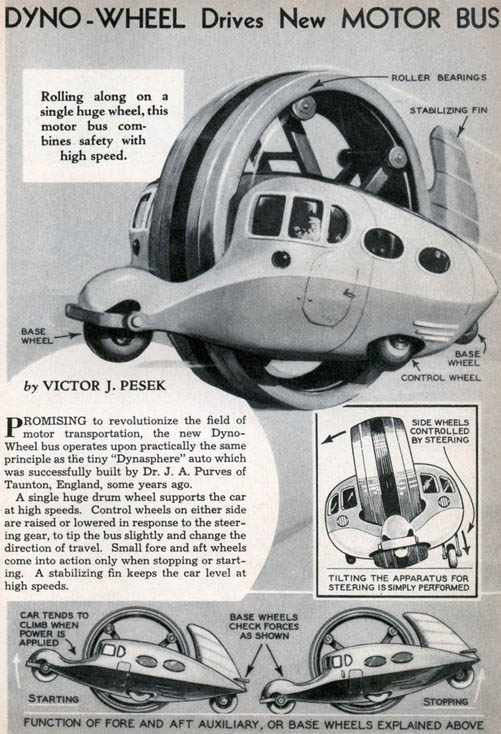
Another fascinating chapter in monowheel history was written by a chap called Dr. John Archibald Purves from England, who seriously believed that one huge wheel encompassing five passengers was far more efficient than a car with four (smaller) wheels. In 1932, Purves designed the remarkable Dynosphere.
This monowheel differed from other designs in various ways. For one, it was wide enough to stand up by itself, without the need of continuous and rather tricky balancing. The outside of the wheel was part of the surface of a sphere, so that it did not touch the ground over its entire width and could be tilted sideways for steering. The outside consisted of a metal framework, so that the driver could look through the openings in the wheel frame.
(pictures provided by David Worth and Tom Anable)
Purves built a few different prototypes that were either petrol-driven or electrically powered. These machines were tested on the beach at Brean Sands and at Brooklands racing track. A short surviving film clip of the latter shows the difficulty in making a smooth ride – even at fairly constant speed – without the occupants gerbilling back and forth inside the wheel. It has even said to have knocked someone over during this test-run because of the inadequate stering system. The project was soon abandoned after that. The last known news from the project was a finished model of a five-seating Dynosphere with an enclosed glassed-in cabin, complete with bumpers and headlights.
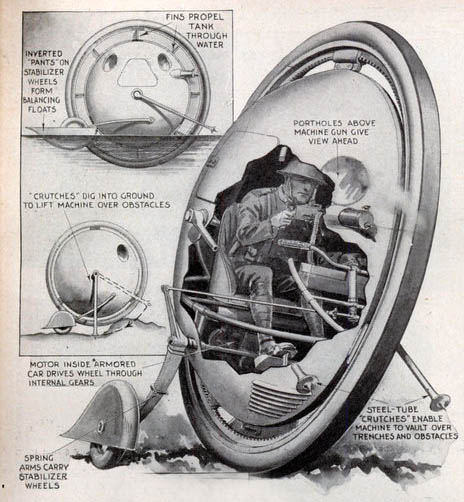
The 1930s saw a couple more unsuccessful monowheels, including the Monowheel Tank Project that never progressed beyond the drawing board, after which it was quiet for decades, when the monowheel made a come-back.
This is only Part 1, the nex will cover the rest of weird mono-wheel vehicles from 1930s to our days, and in the possible follow-ups we will also show some weirdest two-wheels known to man:
Here is, for example, pretty modern Mono-Wheel by Ben Wison (more info) -
"Dark Roasted Blend" - All Kinds of Weird and Wonderful Things, Discovered Daily!"
DRB is a top-ranked and respected source for the best in art, travel and fascinating technology, with a highly eclectic presentation. Our in-depth articles in many categories make DRB a valued online magazine, bringing you quality info and entertainment every time you visit the site - About DRB
Now if only someone could figure out a way to attach four of these things together with some kind of carriage in the middle ... now THAT would be something.
Have you checked out the Bombardier company's concept unicycle? Hydrogen cell for power, anime styling. Good pictures at http://www.gearbits.com/archives/000336.html
There was also the Big Wheel from the 1965 Osamu Tezuka manga/anime series Wonder 3, released in English as The Amazing 3. It's a giant truck tire (about 3 meters or 10 feet in diameter) with a spherical cockpit (about 1.5 meters or 5 feet in diameter) that could travel fast enough to traverse the surface of an ocean or lake. Whee!
Should you not expand the article to include the riot wheel from the burning man concerts and modern electric unicycles? Mine does 24mph, has a range of 30 miles and costs almost nothing to run. It's also small enough to park under your desk so security isn't a big problem.










































 |
|


26 Comments:
Must be a mess in the wet.
And where's general grievous' from the revenge of the sith? Now that was a monowheel!
awesome. you dig up the craziest stuff. i love you daily!
FYI, the Chinese monowheels at the top were probably the ones used in the Olympic closing ceremony.
This also implies the artists during those ceremonies could've been soldiers? Strange.
There was also a steam-powered monowheel in the Japanese Anime, Steamboy.
actually they are the vehicles used in the closing.
and yes, those are soldiers.
they are the artistic section of the military.
almost every military has one.
Great post..!
lots more interesting monowheels here!
http://thenewcaferacersociety.blogspot.com/search/label/monowheels
*wonders why they didn't show mr. garrison's IT*
Now if only someone could figure out a way to attach four of these things together with some kind of carriage in the middle ... now THAT would be something.
Have you checked out the Bombardier company's concept unicycle? Hydrogen cell for power, anime styling. Good pictures at http://www.gearbits.com/archives/000336.html
amoeba - thanks, love your nick
great info everybody, thanks, will use in next part
feng - this is very visual... i can see it oh so clearly :0
Well you did leave of the segway and the single wheel battery motorcycle.
You know those Chinese mono wheels might have been for the Olympic ceremonies, they look the right size.
There's a life size model of a monowheel high-tech (likely conceptual) racer at Johnson Space Centre in Texas.
http://www.flickr.com/photos/bjacques/2233110072/sizes/l/
Thank you Gaz, will go into the next part
These are seriously sexy! I love it!
This comment has been removed by the author.
Sweet monowheel goodness! I must find one and drive it now.
2 words: Don't Brake!
There was also the Big Wheel from the 1965 Osamu Tezuka manga/anime series Wonder 3, released in English as The Amazing 3. It's a giant truck tire (about 3 meters or 10 feet in diameter) with a spherical cockpit (about 1.5 meters or 5 feet in diameter) that could travel fast enough to traverse the surface of an ocean or lake. Whee!
You find the human-powered version here:
www.monovelo.com
Have you seen the ENICYCLE, an electric unicycle using self-leveling technology like the Segway?
Me and a friend are making one. can't wait for it to be finnished.
I tried this one here: http://monowheel-kaufen.de/produkt/monowheel/e400/ it makes so much fun and i cant stop riding it !!!! <3 <3 <3
I really like these monowheels but in germany i am only allowed to use it in my living room or in my private street. Not in the traffic :(.
Look at www.tomanable.com for modern monowheels
And search 'british monowheel association" on facebook for a group of monowheelers doing it today
Should you not expand the article to include the riot wheel from the burning man concerts and modern electric unicycles? Mine does 24mph, has a range of 30 miles and costs almost nothing to run. It's also small enough to park under your desk so security isn't a big problem.
Post a Comment
<< Home