






































 "QUANTUM SHOT" #50 "QUANTUM SHOT" #50 Everything you always wanted to know about Japan, but did not know where to ask Well, now you have a website, called "JAPAN SAQ" (SELDOM ASKED QUESTIONS), which promises to answer ALL your questions, no matter how half-formed or strange-sounding they might be. For example: Q. I have long wondered why Japan is called 'Japan' in English. I know why Korea is called Korea, despite it being Hanguk in Korean, can you enlighten me about the etymology of 'Japan'--why not 'Nihon'? A. The word Japan probably comes from Portuguese or Dutch. Sailors, traders and missionaries from Portugal were the first westerners to visit Japan and they were already calling the country 'Zipangu' or "Jipangu" because they had heard the country called 'Jihpenkuo' in northern China. Another theory is that the word comes from the Dutch word "Japan", which is taken from "Yatpun", the name for Japan which is used in southern China. Because the name was given before the days of political correctness, the Portuguese and Dutch had little interest in using the Japanese words, "Nippon" or "Nihon". ----- Q. Why all the cherry trees and no cherries? A. There are two types of "cherry" trees. One type is bred for its beautiful blossoms (sakura) and the other for its fruit (sakuranbo). If you look closely, you will notice that the cherry trees with beautiful blossoms do have tiny cherries. ----- Q. Why do Japanese people say that women deliver their babies in the TENTH month? A. No, Japanese babies don't take longer to mature. Japanese do not count calendar months, but instead think in terms of lunar months of exactly 28 days. Those few days at the end of each of the 9 months count together for one extra month, hence ten months. (pregnancy is 40 weeks = 10 * 4 weeks = '10 months)". ----- Q. "Why do Japanese people say that they have blue traffic lights when they are really green?" A. According to the book, Japan From A to Z: Mysteries of Everyday Life Explained by James and Michiko Vardaman, the first traffic signals in Japan were blue instead of green, but the blue lights were difficult to see from a long distance away so they were replaced with green ones. Vardaman says that the custom of referring to traffic lights is a holdover from those days. This sounds like a good explanation, but the problem with it is that you will hear Japanese people refer to other green things (like cucumbers, spinach, and sometimes grass) as being blue as well. This is because historically, Japanese people considered green to be a shade of blue. For example, the Chinese character for blue, pronounced ao is made up of two characters, iki (life) and i (well) and refers to the colour of plants which grow around a well, a colour between green and blue. When Chinese people see the character, they say it means green, but Japanese people say it means blue. Japanese books on colours tell us that there are four tertiary colours: red, blue, white and black, and that all others are shades of those four main ones. Ao, therefore, is a sort of ideal blue, halfway between green and blue. The sky is said to be blue, but it is a different shade of ao than a traffic light is. Tree leaves are said to be green, but green is a shade of ao, like crimson is a shade of red. In another interesting cultural difference relating to colour, Japanese children always colour the sun red instead of yellow. ----- Q. Why do Japanese school girls wear sailor suits? A. Of course the obvious answer is that it is to fuel the multi-billion dollar school girl adult industry and drive salary men wild with desire, but the sailor uniform actually originated in Europe. It is based on the British navy uniform which originated in the 17th century and became popular in Europe after Prince Edward (later Edward the fifth of England) was photographed wearing one when he was five years old. They became enormously popular for both boys and girls and were adopted as school uniforms. During the early part of the 20th century when Japan was westernising, it looked to Europe as a model for its education system, and borrowed black military style uniforms for boys, and sailor suits for girls. ----- Q. Many Japanese people have told me that instead of seeing a "man in the moon" in the moon's craters, they see a rabbit. Where exactly is the rabbit? 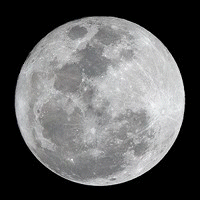  (images source) A. Can you see a rabbit making rice cakes in the image at left? Both Japanese and Chinese people see a rabbit in the moon instead of a smiling face. Not only do they see a rabbit, but they believe it is making mochi (rice cakes). The origin of this idea comes from a play on words. The word mochizuki has a double meaning in Japanese. Although it is written with different kanji, it can sound like either "making ricecakes" or "full moon". ----- Q. Why do hinged doors in Japanese houses usually open outwards instead of inwards? A. Because doors that open inwards would hit the shoes left in the front entrance. ----- Q. I have long wondered how Japanese people look words up in the dictionary. They can't alphabetize their words, so how do they find them? A. Japanese has two kinds of dictionaries, regular ones, where the words are organized by sound, based on the hiragana phonetic writing system, and kanji dictionaries. To look up a word in a kanji dictionary, you have to count how many strokes the character has. Kanji are not written smoothly, the way the English alphabet is. Instead, they are written with a series of brush (or pen) strokes. Kanji can have anywhere from one to 30 strokes. ----- Q. Why are there so many bicycles with squealing brakes in Japan? A. There is actually a very good reason for the squealing brakes. Since 90% of the bells on Japanese bicycles are broken, the noise serves as an effective warning to pedestrians that they have to get out of the way. ----- Q. Why do haiku have to have exactly 17 syllables? A. In order to understand the structure of haiku, it’s important to know a little bit about linguistic differences between the Japanese and English languages because they have had a profound influence on the types of poetry they produced. Two of the most important characteristics of English poetry, rhyme and meter, are almost unheard of in Japanese poetry, and it relies on rhythm instead. The reason for the lack of rhymes is that Japanese has a very limited number of sounds, almost all words end with vowels, so rhyming words do not have the same impact that they do in English. Meter is not possible because Japanese people put the same stress on all the syllables in a word. Instead of using rhyming words and meter in their poetry, people focused instead on the number of morae (phonetic units which are roughly equivalent to an English syllable) to produce rhythmic effects. ----- Q. Why is it that Japan has vending machines almost everywhere you go, but there are hardly any that sell food and snacks? A. Although the taboo seems to be gradually disappearing, it is considered bad manners in Japan to eat while walking, so people are not accustomed to buying food from vending machines. ----- Go and read the rest of that huge list of cultural oddities and interesting facts. Discover, for example, why Japanese writing is rather vertical than horizontal ( because the letters were usually written on tortoise shells), why Japanese houses do not have basements, and is it true that most Asian babies have a blue spot on their butt when they're born... (yes it's true, it's a dense collection of Melanin-containing cells on their lower backs). The page is constantly updated with new answers, so visit there more than once. Or better yet, go visit Japan, what are you waiting for?..   (images source) Permanent Link... 
|
Scroll down for comments:
|
|
7
comments
 |
|
RECENT ARTICLES:

|
Visual Caffeine #8 Visual Caffeine, Issue 8 A thrilling blend of art, myths and technology |

|
Visual Caffeine #7 Visual Caffeine, Issue 7 A thrilling blend of art, myths and technology |

|
Art Deco Imperial Dreams: Art Deco Update Wings, Gears, & Glamorous Ladies |

|
1970s SciFi DRB Pics-of-the-Day Grand Space Adventure 1970s Art |
"Dark Roasted Blend" - All Kinds of Weird and Wonderful Things, Discovered Daily!"
DRB is a top-ranked and respected source for the best in art, travel and fascinating technology, with a highly eclectic presentation. Our in-depth articles in many categories make DRB a valued online magazine, bringing you quality info and entertainment every time you visit the site - About DRB
Connect with us and become part of DRB on Facebook and Twitter.
YOUR COMMENTS::
|
|

|
SF ART & BOOK REVIEWS: Don't miss: The Ultimate Guide to NEW SF&F Writers! Fiction Reviews: Classic Cyberpunk: Extreme Fiction Short Fiction Reviews: Lovecraft's "At the Mountains of Madness" (with pics) New Fiction Reviews: The Surreal Office |
READ OTHER RECENT ARTICLES:

|
Abandoned, Dieselpunk DRB Pic-of-the-Day Abandoned: Streamlined Three-wheeler |

|
Visual Caffeine #6 Visual Caffeine, Issue 6 A thrilling blend of art, myths and technology |

|
Visual Caffeine #5 Visual Caffeine, Issue 5 A thrilling blend of art, myths and technology |

|
Hellish Weather on Other Planets
Wild, Untamed, and Uncut |

|
Medieval Suits of Armor
Metal Body Suits vs. Weapons of Medieval Destruction |

|
World's Strangest Theme Parks
Amusement to the (twisted) extremes! |

|
Enchanting Victorian Fairy Tale Art
"Then world behind and home ahead..." |

|
Adorable Pedal Cars
Collectable Pedal Vehicles Showcase |

|
Japanese Arcades: Gundam Pods & Other Guilty Pleasures These machines have gone up to the next level |

|
Modernist Tallinn Architecture Delicious blend of old and new! |

|
Early Supercomputers: A Visual Overview "Computers in the future may weigh no more than 1.5 tons" |

|
Futuristic Concept Cars of the 1970-80s French, Italian & Japanese rare beauties |

|
Epic 1970s French Space Comic Art DRB Time-Slice: Valérian and Laureline |

|
The Trees Are Escaping! The Abandoned Prison in French Guiana "Great Escape" from the Devil's Island |
|
FULL ARCHIVES (with previews, fast loading): 2022/16 2015/14 2013 2012 2011 2010 2009 2008 2007 2006 Link Lattes Feel-Good & Biscotti Issues |
|
CATEGORIES:
Feel-Good! | airplanes | animals | architecture | art | auto | boats | books | cool ads | famous | futurism | food
gadgets | health | japan | internet | link latte | military | music | nature | photo | russia | steampunk
sci-fi & fantasy | signs | space | technology | trains | travel | vintage | weird | abandoned


7 Comments:
I'd never have guessed about that rabbit on the moon.
To the Japanese, the image is of a rabbit pounding sticky rice in a mortar to make rice cakes. The Chinese have a story about the rabbit trying to create the elixir of immortality. From India to Japan, there is a story about how a deity (Indra, Buddha, Lord of Heaven, etc.) disguised himself as an old beggar. He came upon a monkey, a fox, and a rabbit. He said he was starving and asked them for something to eat. The monkey and fox were able to find some tidbits for the old man to eat, but the rabbit could not find any. So he started a fire and cooked himself for the old man to eat. The old man returns to his original form and puts the rabbit in the moon for all eternity as a reward for his selflessness.
A couple more interesting facts about Japan. Men shave their heads to apologize, and women cut their hair when they break up with their boyfriend.
Sadly - the link to more interesting facts about Japan at the end of this article is a broken link.
Still, your website kicks butt :)
its actually bad for you to eat or drink while walking weirdly enough. the japanese are right there.
Try this link instead. It was updated some time ago.
Mexicans also see a rabbit on the moon.
Post a Comment
<< Home