|
|
 "QUANTUM SHOT" #382(rev) "QUANTUM SHOT" #382(rev)
Link - article by Avi Abrams
Glorious Retro Airships and New Extreme Dirigibles for the Modern Age
"Would you like to ride in my beautiful balloon...
We could float among the stars together, you and I...
The world's a nicer place in my beautiful balloon...
We can sing a song and sail along the silver sky... For we can fly!"
("Up, Up and Away" by the Fifth Dimension)
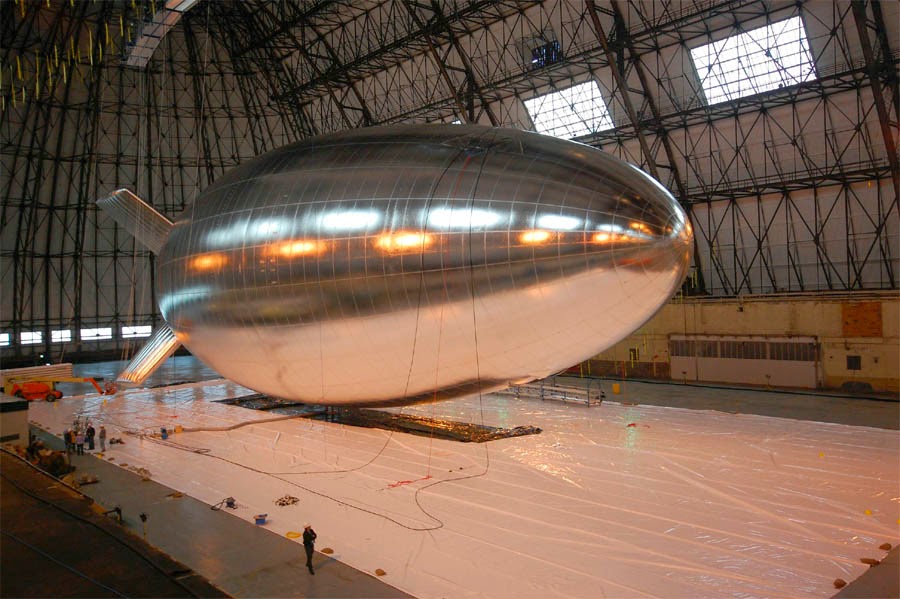
(Lockheed Martin's HALE-D airship in a hanger, image and more info via)
"There were giants in the air..."
Leviathan-like airships (especially the gargantuan, biggest ones) have always held human imagination in thrall, and have been inspiring myriads of engineers to come up with something feasible and lovely to behold, to gracefully soar to the skies, haul lots of cargo and cover large distances. Even the process of construction of such huge airships is beautiful to observe, a process sophisticated and intricate enough to warrant attention today and dream about building even larger "Kings of the Air":

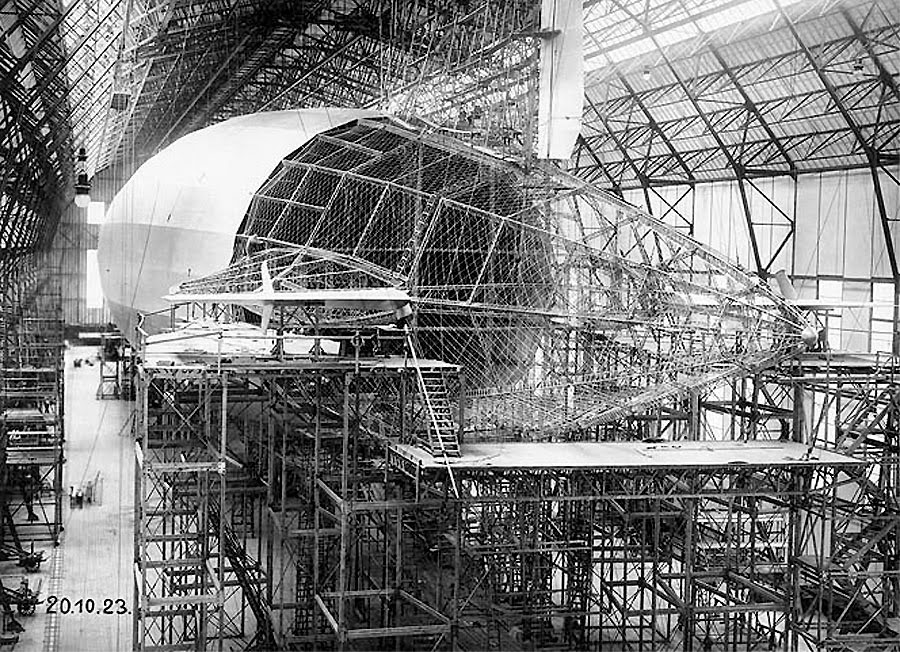
(interiors of airships during construction, images courtesy Brian Lockett, Air-and-Space.com)
See people working on top of the giant fire ladders used in construction of LZ-127 Graf Zeppelin:
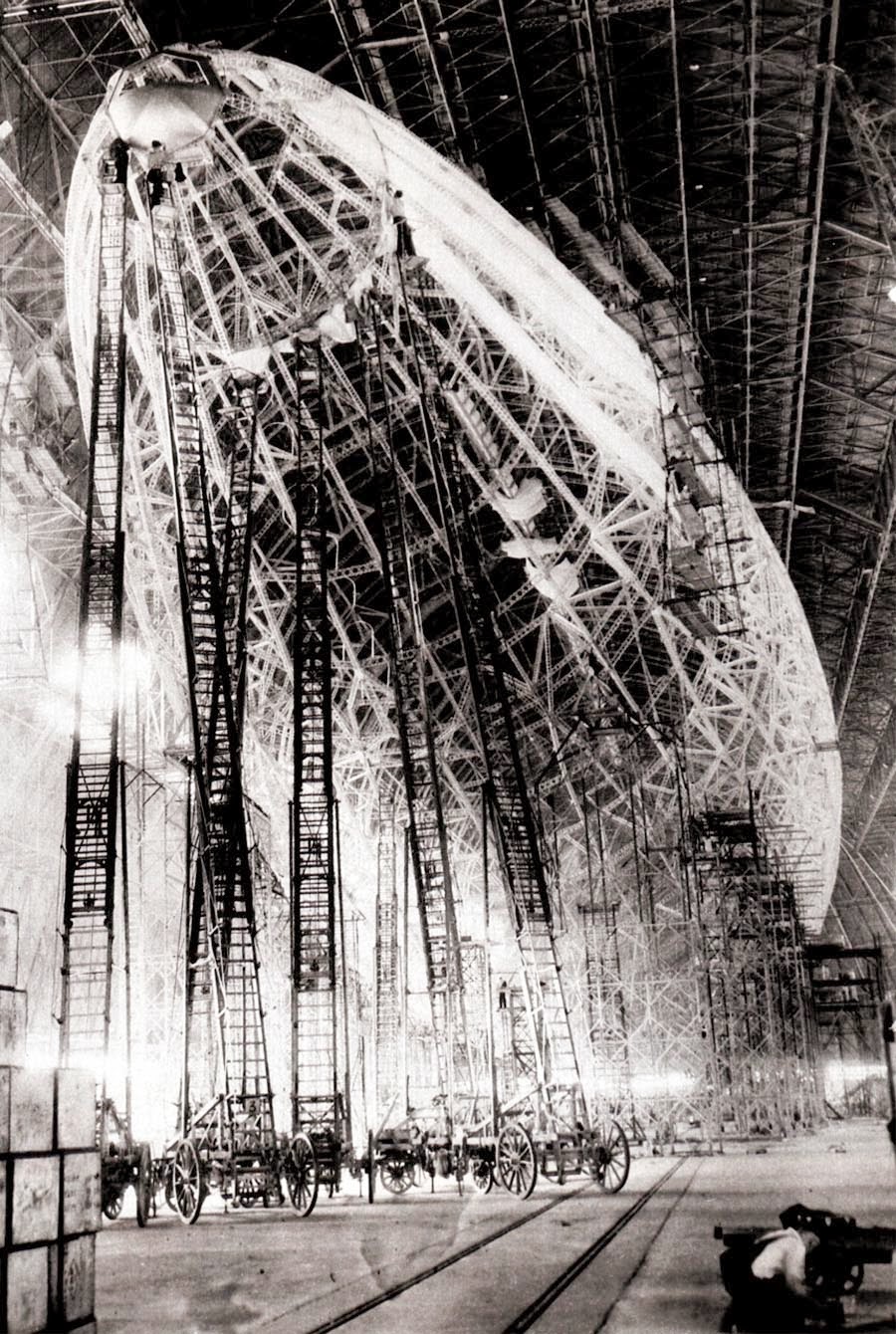
(image via)
Looking along the axial gangway from the nose of LZ-126 under construction:
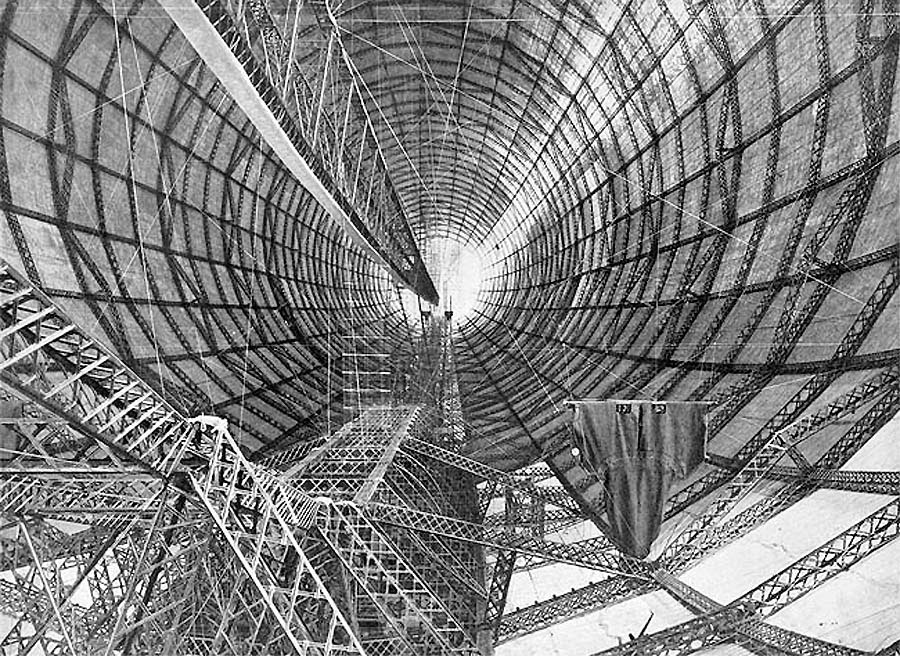
(interiors of airships during construction, images courtesy Brian Lockett, Air-and-Space.com)
Now largely extinct, the ponderous "islands in the sky" (how "airships" were sometimes called in popular magazines) were all the rage during the dawn years of aviation, firing up the public imagination and getting lots of financing from the politicians of the time. To properly appreciate the grand scale of these beasts, compare their size with puny humans: here is the LZ-127 Graf Zeppelin, for example -

"The Hindenburg trundles into the U.S. Navy hangar, its nose hooked to the mobile mooring tower, at Lakehurst, New Jersey, on May 9, 1936" -
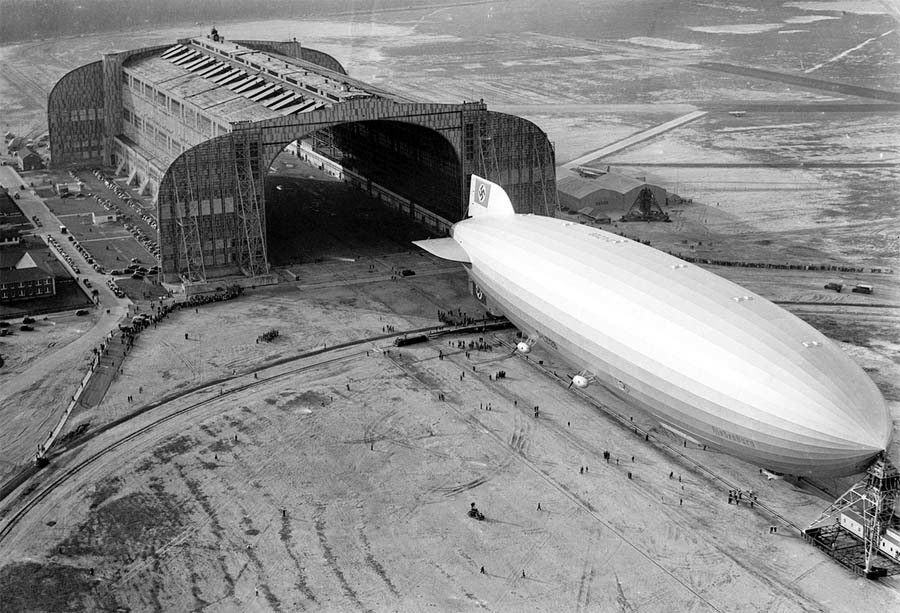
(image credit: AP Photo, via)
Compare the size of these airships with hangars needed to accommodate them, or with (puny by comparison) mooring towers:

(images via 1, 2, Newport Historical Society)
Entirely in line with the general luxury trend of the Era of the "Titanic", the Graf Zeppelin's interiors were as glamorous as inside any prestigious hotel:

(images credit: Airships)
In the early 1930s airships "Graf Zeppelin" and "Hindenburg" flew regularly on transatlantic routes between Germany and America. As was so skillfully shown in the movie "Sky Captain", these airships were designed to moor at the most prominent skyscrapers:

(screenshot from the movie "Sky Captain & The World of Tomorrow")
The observation tower at the top of the Empire State Building was originally intended to be a dock for mooring airships (read more about "how the engineers crowned world's tallest building"):

(image credit: nytstore)
Airships were mooring to the skyscraper dock even while the Empire State Building was under construction! Here is the rare archive photo to prove it:

(image viaAirships)
This idea has made its way into some futuristic illustrations:

(left image credit: Arthur Radebaugh; right image: original unknown)
Airship Skyport from the November, 1939 issue of Popular Science, required a much bigger skyscraper to be built than the puny Empire State Building, shown for size comparison in the right corner of this fabulous image:

(image via)
Or check out this gargantuan idea: the Airport Docks, envisioned by architect Harry B. Brainerd in 1931; note the Zeppelin in the middle dock:

(image credit: via)
For more info, see the "Zeppelins Through the Ages" catalog here - a wonderful site, full of info and trivia, collected by Daniel J. Grossman.
There is something about "Zeppelins over Manhattan" images...
As a symbol of the bygone era, these image hold a certain mystique: the airborne giants made a perfect picture floating over Manhattan as a counterpoint to all these skyscrapers, and many photographers recognized it:

(image credit: U.S. Naval Historical Center Photograph)
USS Macon over New York, in 1931:

(image credit: U.S. Naval Historical Center Photograph)
USS Los Angeles in 1932:
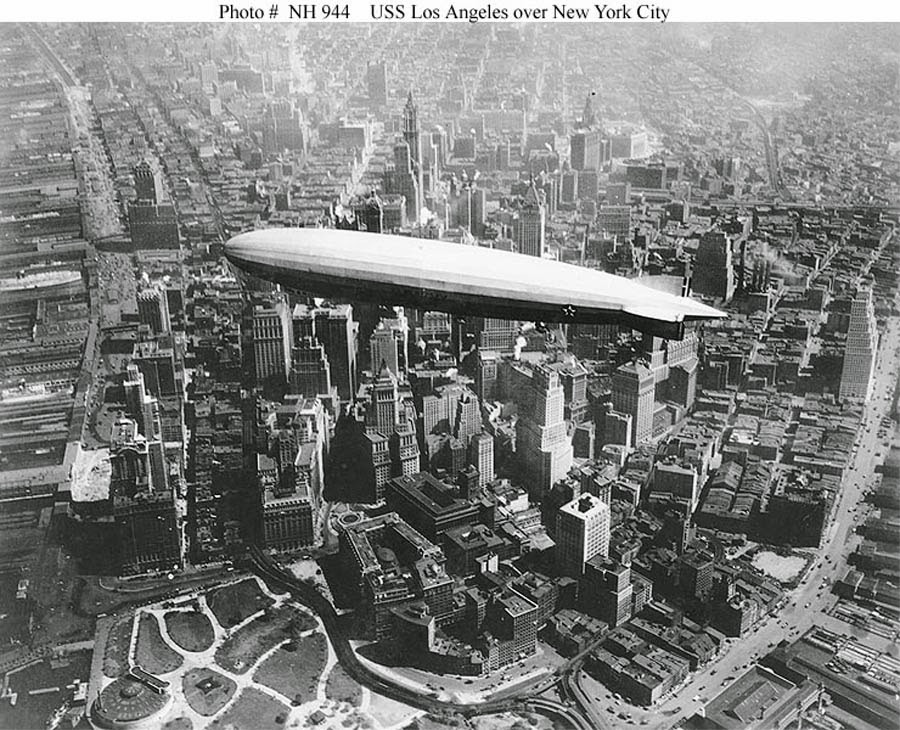
(image credit: U.S. Naval Historical Center Photograph)
To browse through "scale progression" of airships (many of them hypothetical), head over to this site. It clearly illustrated how "bigger is better" applied to airship really made sense to designers (note little airplanes underneath them):


(bottom image: war-time blimps wait in the hangar; images via)
US Navy actually built two zeppelin aircraft carriers: USS Macon (info) and USS Akron ZRS-4. You can see them on the archival photos shown below: these tiny dots at the bottom are people! -
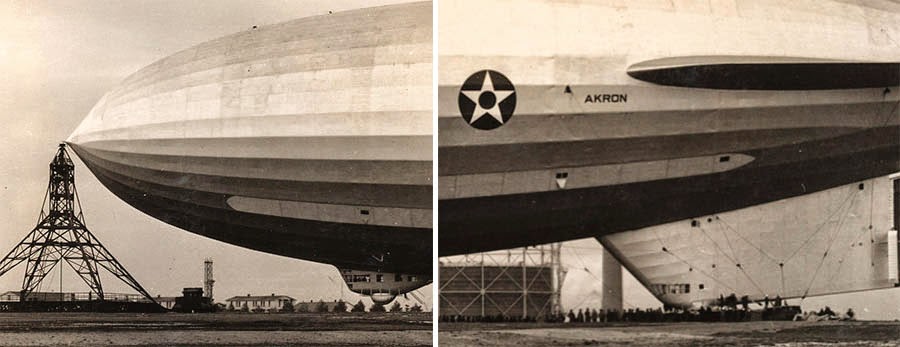
"Akron" could carry four airplanes, "Macon" could carry five, and the further models were designed to carry up to 22 airplanes!... All of this found its culmination, perhaps, in this idea: "The Aerial Landing Field" from Modern Mechanix, October 1934:


(image via)
Also check out this screwy-looking dirigible from Modern Mechanix (August, 1930): revolving spiral vanes propel it through the air, while the ENTIRE gas shell revolves around the stationery aluminum framework! -
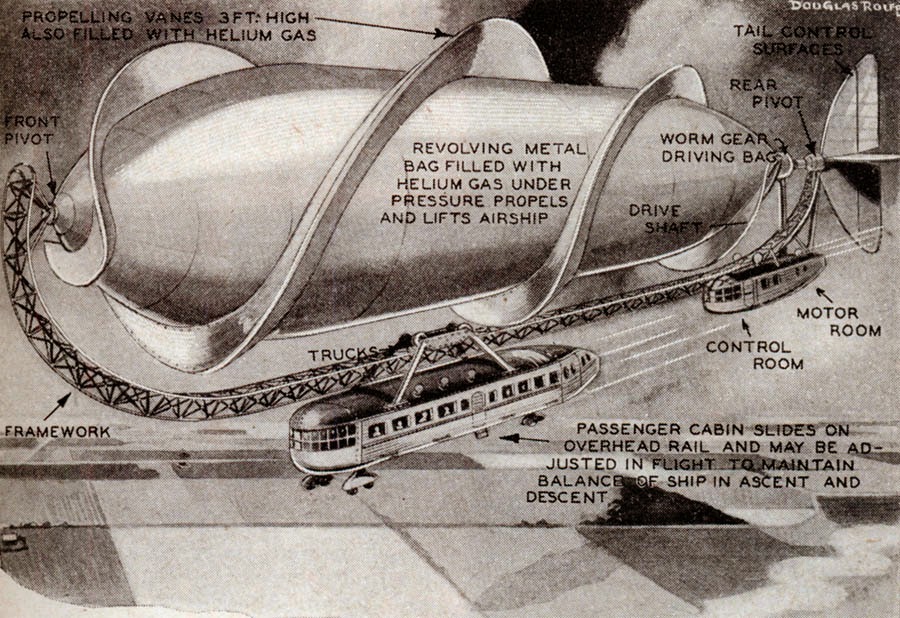
(image via)
The Zeppelin Dream Persists!
Futuristic air wars gain a whole new dimension if fought with giant airships and weapon-outfitted Zeppelins. Seen in many pulp stories during the Golden Age of Science Fiction in the 1930s, the idea (and the accompanying spectacular vision) persisted into the 1970s - for example, in Michael Moorcock's novel "The Warlord of the Air", where the Edwardian technology takes to the air in a sort of precursor to the steampunk genre (see left image below):

Right image above shows exciting graphics for the movie "Zeppelin vs. Pterodactyls" (more info).
Here are some other futuristic visions: Frank Tinsley drew this image for the 1957 book "Airships in the Atomic Age", including the interior for the Atomic Airship:


(image credit: Marc Brown)
Communists also liked to dream large-scale: this is the Russian Nuclear Airship, complete with a helicopter pad and a small exploration bi-plane:



(images source: "Tekhnika Molodezhi" magazine, Russia, 1971)
Grand Missionary Effort
The idea of a giant ship that can carry "bridges, buildings, fleet of trucks; that eliminates the need for roads, railroads and harbors" was kept alive all through the 1930s and beyond: this book documents a history of the project, dubbed "The Deltoid Pumpkin Seed". Financed by private individuals (most of them presbyterian missionaries), after 12 years and half a million dollars, the Aereon Corporation had a static ship model and plenty of wrecked ones (read more here)
The Aereon 26 strange-looking plane actually took to the sky in 1971:

The company's research, however, opened many paths toward creating stealth airships for the military (some weirdly giving rise to more UFO mythos and spotting):

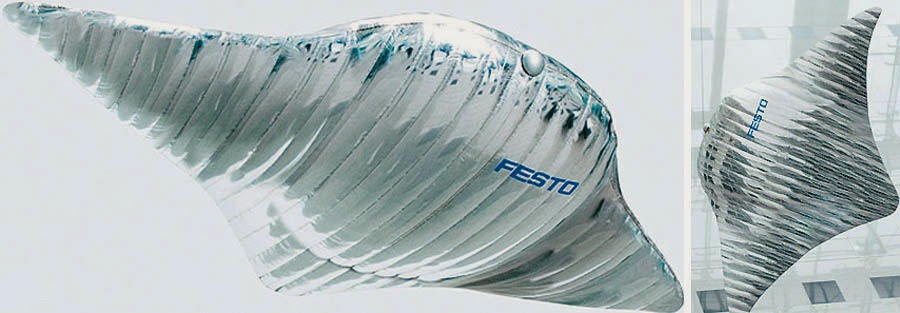
Inspired by Nature: "Festo Air-Ray"
The Air_Ray flying structure mimics the movements of a manta-ray, complete with a "beating wing drive"! It also reminds us of the war-bird machines in the "Sky Captain: World of Tomorrow" movie. This airship seems to be the ultimate expression of bionics: uniting natural fluidity of movement and effortless dynamics with practical (even if still in a concept stage) application.
(images via)
The undulating movements of this bionic marvel are quite hypnotizing (watch the flight simulation video here). By adjusting the angle of wings the craft can fly forward, backwards and change direction fluidly and naturally.

(images via)
The Millennium Ship
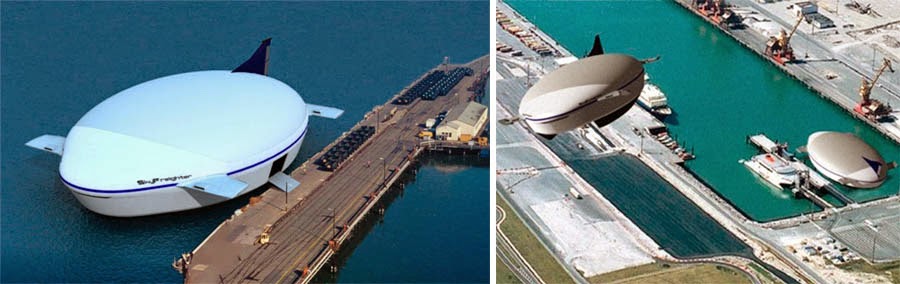
The Millennium Airship company has come up with the revolutionary SkyFreighter, designed to lift super heavy cargoes and transport any large equipment in one piece, without the need for re-assembly. It can haul five-hundred-plus tons and can cruise at speeds averaging 100 mph (for a distance of 6000 miles if necessary, with no refueling):
(images credit: Millennium Airship)
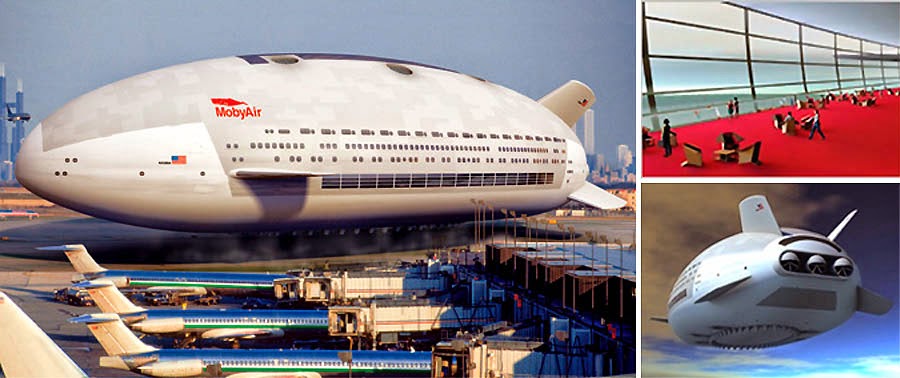
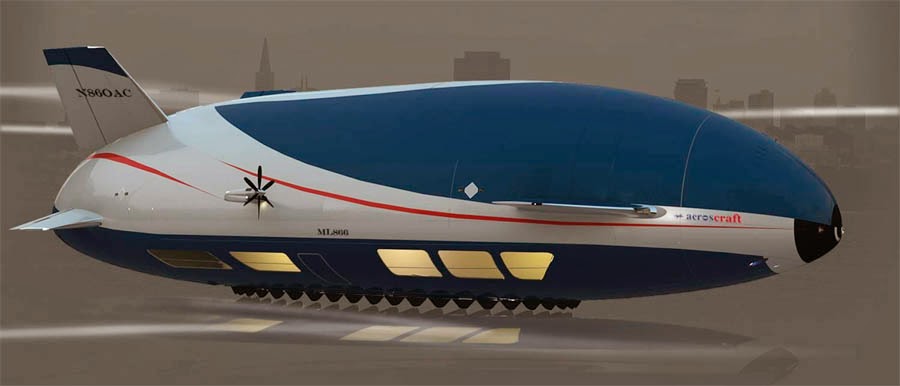
Although we did not hear about any progress from the original concept drawings, Popular Science magazine a few years back featured the Moby Air: the Flying Luxury Hotel. This wonderful vessel by Worldwide Aeros Corporation is appropriately huge, boasts some pretty good specs, and can carry 288 passengers in ultimate luxury to the cruising altitude of 8000 ft -
(image via)
In conclusion, we have to say that if the longevity of airship concept is any indication (just witness how persistent inventors and engineers are to get this method of transportation off the ground and into everyday use), we are going to see some embodiment of this dream in development continuously: there will be new approaches and improvements on the idea at any point in time. After all huge cargo skyships make good economical sense (all safety factors notwithstanding), and so we will live to see the day when airships flying over the Golden Bridge in San Francisco, for example, will become commonplace.
Article by Avi Abrams, Dark Roasted Blend.
CONTINUE TO "AIRSHIPS & TENTACLES" ->
Also check out our popular "AMAZNG AIRPLANES" series! ->
|
|
RECENT ARTICLES:
"Dark Roasted Blend" - All Kinds of Weird and Wonderful Things, Discovered Daily!"
DRB is a top-ranked and respected source for the best in art, travel and fascinating technology, with a highly eclectic presentation. Our in-depth articles in many categories make DRB a valued online magazine, bringing you quality info and entertainment every time you visit the site - About DRB
Connect with us and become part of DRB on Facebook and Twitter.
YOUR COMMENTS::
READ OTHER RECENT ARTICLES:
CATEGORIES:
Feel-Good! | airplanes | animals | architecture | art | auto | boats | books | cool ads | famous | futurism | food
gadgets | health | japan | internet | link latte | military | music | nature | photo | russia | steampunk
sci-fi & fantasy | signs | space | technology | trains | travel | vintage | weird | abandoned
|
|












































































 |
|














22 Comments:
When I was younger, I was fascinated by the airships and zeppelins of the early part of the 20th Century. In fact, I have a book called "Zeppelin: The German Airship Story", which touched on their rise and fall. I am struck by the fact that they could never seem to get the design of these monsters right, and the majority of them crashed to Earth or burned up. If you can find a copy of this book, snag it. It's very fascinating.
Great article! Looks like they finally got it right!
There are still airship hangars at Cardington in the UK. Check out the pictures on their web-site: http://www.controltowers.co.uk/C/Cardington.htm
You cannot believe the immensity of them unless you've been there, as I have. The pictures just don't do them justice
These are the Cardington hangars on Google Earth: http://tinyurl.com/3dc4k3
Yes, Zeppelins certainly will become a familiar site in the skies over San Francisco! BTW, we're Airship Ventures, not Airship Adventures as you credit us on a couple of the images.
www.airshipventures.com
airshipventures.blogspot.com
one of the tallest buildings in Europe is an aqua spa in the hangar of a bankrupt modern zeppelin construction factory: http://www.tropical-islands.de/de/presse/pressefotos.html
and the central market in Riga is one of the biggest dayly markets in Europe and is in the old zeppelin hangars from the early 20th century
Thank you for the link; what a great collection of images!
The mooring mast on top of the Empire State Building seems to have been a publicity gimmick more than anything else. Certainly, it wasn't very well thought out: it was far too windy up there to be viable. Still, I did like seeing it in use in Sky Captain.
We still have new, ACTIVE airships here in Elizabeth City, NC. Production and maintenance is on the old Weeksville Naval LTA Base. http://elizcity.com/weeksnas/
http://www.newbegun.com/tour/Airship_Hanger.php
http://www.newbegun.com/tour/Bicycling_02.php
thank you all... wonderful info
The real Problem with Airships is, that Helium is extremely rare. As a tecnician at the Zeppelin Yard in Friedrichshafen explained to me, there is only about enough helium to fill two of the once proposed "Cargolifter" Airships. Until we synthesize a light gas we probably wont see alot of these Dreams come true.
Airships are still wonderful ships and could be on the way back. See my 2006 post that covers much of what's on here: http://www.creationrobot.com/2006/03/airships-they-are-coming-slowly-from-many-different-companies-and-countries/
yes the gas is a problem but not the rare is the point ,but the priece.
the cost of one fill for the cargolifter is more expensive than the rest of the zeppelin.
sry for my bad english. ^.^
Thank you, Creation Robot - great link!
Hey there great article just blogged about it at Airshipworld. Here ist the Link: Dark Roasted Airships
Regards
Andreas
--
Editor of Airshipworld
--------------------------------------------------------
Visit the Airshipworld Blog at
http://airshipworld.blogspot.com
--------------------------------------------------------
Thank you Andreas, we'll keep a close look on your site.
The problem with airships of the past was that they were ahead of their time. The problem was materials and the flotation gas.
The outer materials used to "protect" the skins of these beasts turned out to be the same formulation used for solid rockets today.
The gas normally was helium, but Germany chose to use Hydrogen because the only source of helium was the USA.
The structure of these beasts were typically made out of Aluminum, a fairly new metal not quite mastered. A lot of structural failures occurred because engineers assumed Aluminum was lightweight iron, which it wasn't. Aluminum, while strong, has different characteristics, which require different engineering considerations. Hence the designs were always flawed.
Today we have carbon fiber based composites, super adhesives, light-weight fabrics and polymers, and a far superior knowledge of metals.
There is one problem, however, there is a finite supply of helium, and once it's gone, it's gone. It's so light, it just leaves our atmosphere.
Hi Avi,
I'm looking for a higher resolution copy of your image titled "USS Macon over New York, in 1931."
ussmacon3.jpg
I'd like to make a print to put up in my living room.
Could you help me out or direct me to the source?
cheers,
Kosta
Try this link - http://en.wikipedia.org/wiki/File:Uss-akron-manhattan.jpg
Thank for such thematic stuff. And you could get any info about aeronautic direction from the Aerocrat blog in LJ - http://aerocrat.livejournal.com
The Russian original of the one you could translate via google's translating service.
There are several reasons Zeppelins will never make a come back despite the efforts of those uninformed of the reasons for its prior demise, and every failed technology has the same followers who say - we can fix that now...except the magic bullet invariably helps whatever alternate technology exists more.
First of all, the majority of rigid airships were lost due to weather, not the (vastly overrated) inflammability of the filling gas so changing the gas won't help.
Structural engineering wasn't a problem either.
The primary problem is that because it is lighter than air, it has vastly more surface area than mass, and tends to get pushed around by gusts of air.
Updrafts and downdrafts easily exceed the ability compensate. Stronger winds still (but still of little concern for any airplane of the past 50+ years) can cause stresses on the structure beyond its capability to absorb, while building it to handle those stresses would result in it being too heavy to be useful.
Unlike an airplane, it cannot apply sufficient power to overcome strong wind gusts because the power would add weight both in engines and in associated structure and so again runs into a weight wall.
It is reliant on two control systems. The first is aerodynamic, which works poorly at the speeds typical of an airship.
The second is buoyancy control, either shifting buoyancy fore and aft or on controlling the overall buoyancy, but this cannot be controlled quickly enough to deal with changes in air pressure in even the smallest storm, even if losing lifting gas isn't a problem.
Hydrogen and helium leak out of whatever you put them in. You can't stop that unless you want an airship that's too heavy to fly. That means they have to be topped up - a considerable ongoing expense that would seriously reduce their utility in the few markets available since large quantities would need to be made and/or shipped.
When the airship was at its peak, it was faster than heavier-than-air aircraft but lost that advantage during the course of WW1 and never got it back. Into the 1930's it could offer range, and without stopping it remained competitive speed-wise but that disappeared with faster and longer legged aircraft, along with the flying boat (which had similar weaknesses). A small market potential remains, but not for passenger airships, and definitely not for large ones. No doubt others think differently (otherwise Zeppelin AG and others wouldn't still be finding investors) but the only markets are on the fringe, and yet they would still be in danger from inclement weather. Modern weather forecasting is a huge improvement and many weather systems can be avoided - but not all and it would still be in danger sitting on the ground waiting for a storm to pass. Composites mean the structure can be stronger than before but will never be strong and light enough, and computer control will help with some of the difficulties in handing and newer materials will reduce the loss of gas but none of it will ever really be enough. Helicopters can lift heavier and heavier loads, and if you want a scenic tour, there is always the train or a light plane.
I do believe that it is good to review previous technological failures since not all are insoluble and lessons can be learned - alas few lessons ever are.
The majesty of a flying vehicle (either being in it or watching it) nearly a thousand feet long remains as the technology's sole prerogative, and the engine that drove the whole enterprise from 1914 onwards. If it wasn't so ridiculously huge it would never have had so many adherents, yet it served no purpose once it was passed by in the very dawn of aviation. Kudos to Zeppelin though, for keeping the dream alive as long as he did.
Very insightful comment, thank you. Contact me by email, maybe we can write on similar subjects on DRB.
One quibble: Your pictures of the 'Macon' and 'Charlotte' from Wolf Shipyard are speculative. The Charlotte never existed and the Macon carried its fighters internally. It had 2 hooks or 'trapezes' on its underside: One attached to a crane which planes would attach to to be lowered out of or raised into the hull. The other was a rigid hook a ways back from it on which a plane could 'rest' and conserve full while waiting for the main trapeze to become available.
The picture shown here is what Macon would have looked like had a proposed refit gone ahead. This would have lengthened her hull, giving her more lift and range, and allowing more fighters to be carried externally.
Thank you Sean, great info. We will be making Part Two, so let us know if you have any contribution to make.
Post a Comment
<< Home