|
|
 "QUANTUM SHOT" #189(rev) "QUANTUM SHOT" #189(rev)
Link - article by Avi Abrams
Boeing-2707 SST: a Supersonic Marvel, Largely Forgotten Today
Capable of transporting 296 passengers across the ocean at 2900 km/h, developed 40 years ago, in 1968...
The Sixties (or for that matter, the Fifties) were truly amazing years when it comes to development of fascinating - and often futuristic - technology. The automotive industry, for example, entertained public imagination with powerful full-size cars, a true embodiment of the "American dream" and sheer optimism of the times. In space exploration, we reached all the way to the Moon; in air travel, the dream of an American-made supersonic passenger plane seemed almost certain to become reality.
Witness "Boeing-2707" SST (Supersonic Transport): a beautiful streamlined airplane, almost as big as a Jumbo jet and capable of Mach 3 speeds (much faster than the Concorde):
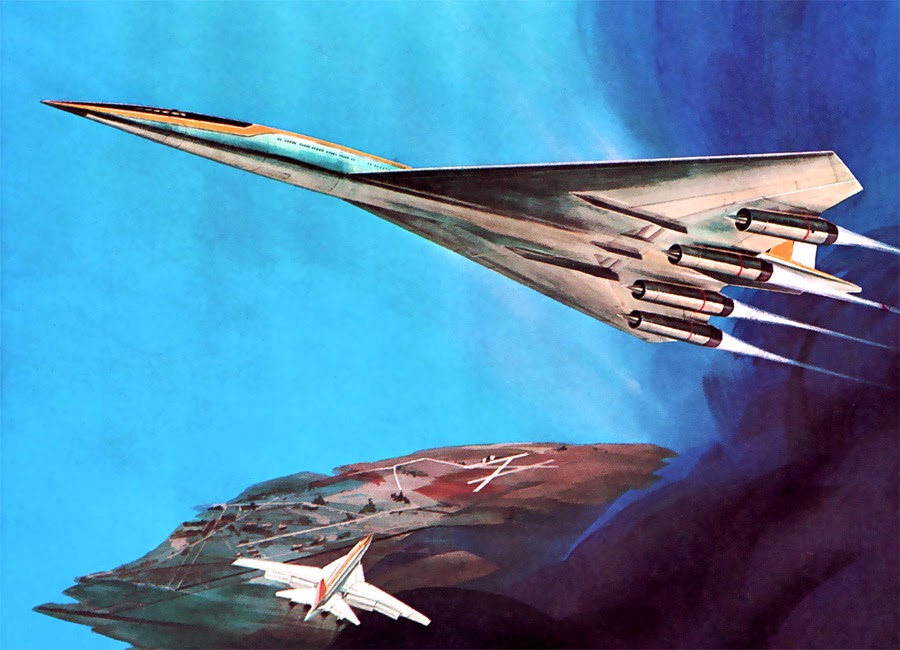

(top image via)
America enters the race... achieves great results, and... well, let's just say it was good while it lasted
It all started in 1952 with a small-scale study of the feasibility of SST designs by the Boeing company, and things heated up significantly when in 1962 the governments of Britain and France decided to join efforts in the creation of a supersonic Concorde airplane. Then the intrepid Russians also came up with the Tu-144 aircraft (which proved to be as capable as the Concorde, but, sadly, was plagued by accidents and grounded after only 55 passenger flights).
The American government nearly panicked at this point (remembering all too well the embarrassment of the Cold War space race after the "Sputnik" launch) and quickly responded with its own program for Supersonic Commercial Air Transport (SCAT) development. The "SCAT" program got endorsement from President Kennedy himself in 1963 - and the race for dominating supersonic airways was "on".

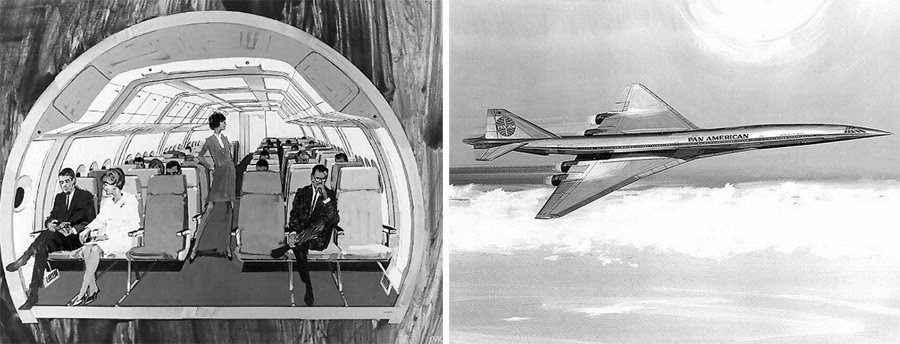
(images via)
It's worth noting that back then it was widely believed that all future commercial aircraft would be supersonic (which just shows how futuristically-inclined general thinking was in the 1960s). The goal was to produce a commercial aircraft capable of carrying at least 250 passengers (twice as many as the Concorde) at Mach 3 speed, with a Transatlantic range of 4,000 miles. Such was the dream... loftier than the competing European projects, perhaps even as glorious as the idea of reaching the Moon.
Development of Boeing 733: from a "delta wing" to a "swept wing"
The proposed plane would be almost twice as large as the Concorde, will cost two times more (here is the seed of its eventual downfall!) and require twice as much time to build, but it would be the "American Dream" plane, the future of the world's airways (FAA estimated that five hundred of such airplanes will be in use by 1990):

(right image via)
This picture clearly shows the proposed Boeing 2707 SST being at least as large as the Boeing 747 Jumbo jet, if not larger:
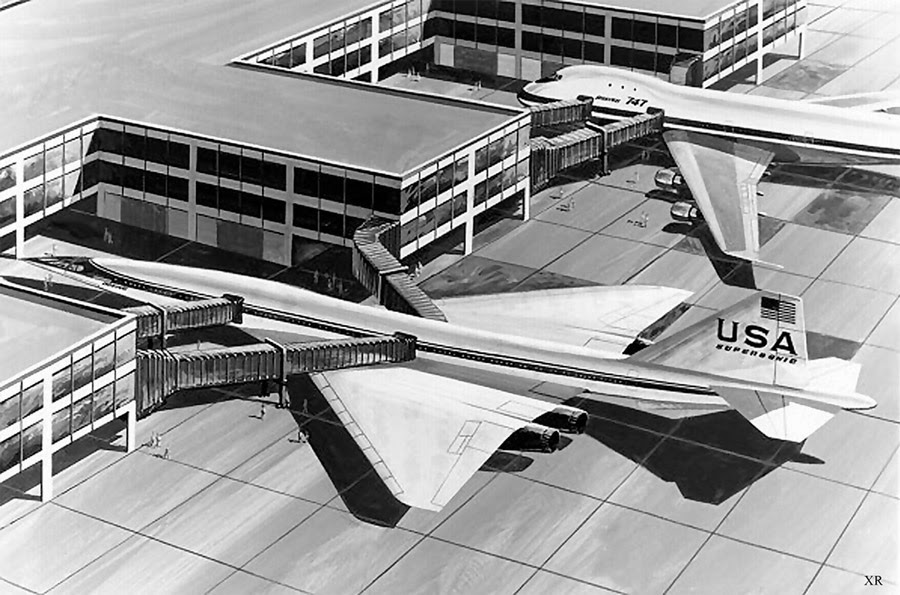
(image via)
Here is the conceptual development of wing geometry (with variations on a delta-wing and a swing-wing theme); on the right is the air tunnel testing of a Boeing 733 model:

(images courtesy of NASA)
The "variable wing" geometry has got quite a history the US already, by this time (read this article for example), plus considerable data has been already accumulated by the military after developing the XB-70 "Valkyrie" strategic bomber and the YF-12 «Blackbird» spy plane. All this gave reasons for American engineers to boast that European supersonic aircrafts were based on already nearly obsolete technology - and while American planes may not go into production first, they most certainly will end up to be the best!
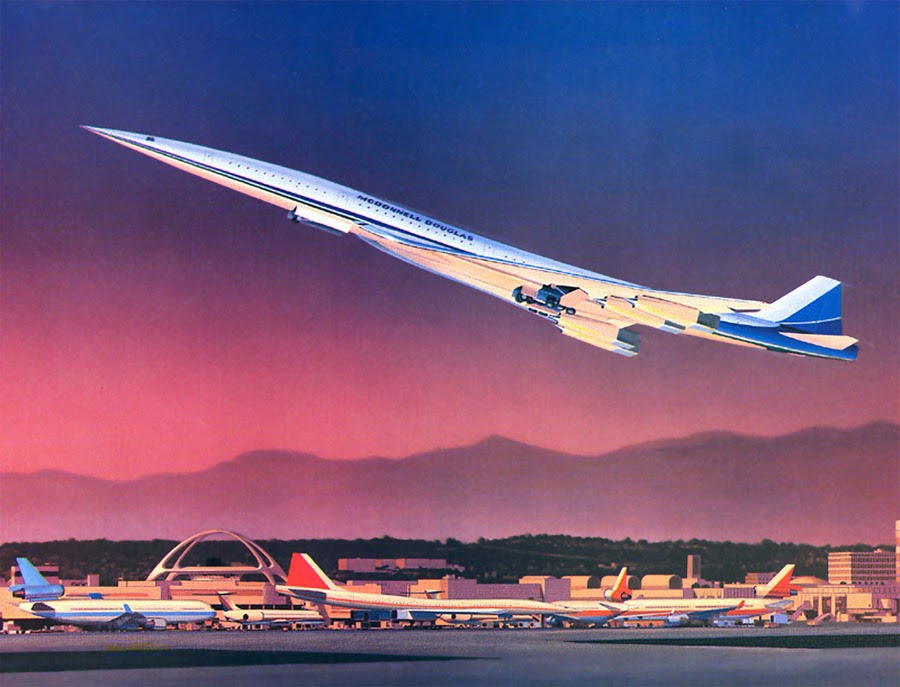
(The McDonnell-Douglas SST proposal in 1966; image via)
Some of these concepts looked like the F111 fighters with a "variable geometry" wings added on (perhaps a legacy from the TFX program), while others could pass for a Rockwell B-1 bomber prototype. While Boeing was clearly making some progress, it did not enjoy a monopoly on SST research for long. In 1964 the government admitted "Lockheed" into preliminary design competition - while "North American" (responsible for the development of the X-15 Rocketplane) was strangely declined. Thus, two giant corporations ended up pitched against each other, and the design race has nicely heated up.
Lockheed 2000: a honorable mention.
This baby was admirably full-size, boasting very healthy stats: some models could transport up to 300 passengers with a range of 3500 miles. The Lockheed mock-up was proudly presented to the judges in 1966, but the rival Boeing-2707-100 was already in the works, capable of taking that many passengers and more, featuring better aerodynamics and less noise pollution. Not surprisingly, Boeing emerged the sole winner of the government contract.
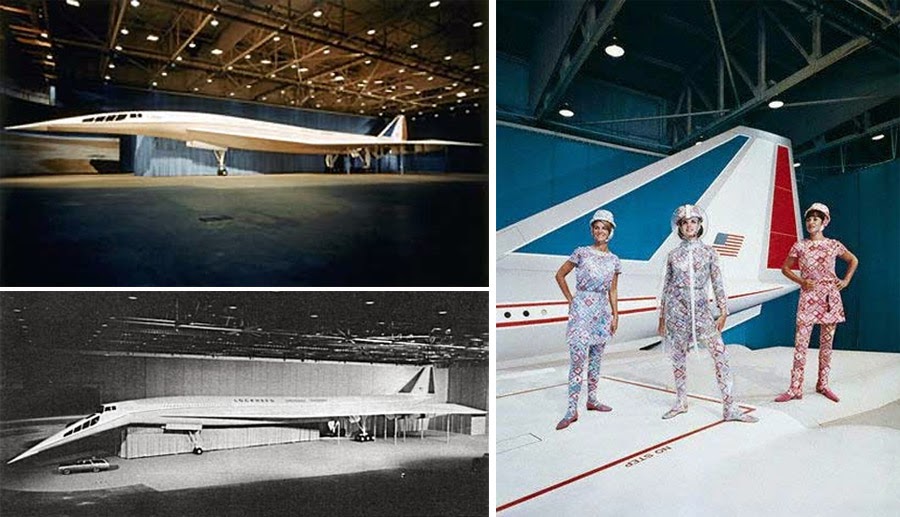
(images courtesy of Lockheed)
Note: spacesuit-like helmets on cute stewardesses were all the rage in 1960s, in case you did not know. See our previous article Glamour in the Skies for more of the Braniff Airlines helmeted uniforms, designed by Emilio Pucci.
Boeing 2707-100: growing longer and sleeker...
With engines now in the tail section (removed from under the fuselage due to safety concerns), "Boeing 2707" retained the variable geometry wing configuration and a distinctive two-hinged "droop-nose" - added to impove visibility during takeoffs and landings. A new name also reflected the fact that the plane's speed was now an impressive Mach 2.7.


Boeing 2707-200: almost there!
New 2707 model proclaimed return to a tailed delta wing - ironically, the very same configuration of a rejected Lockheed entry. By October 1968 it was decided to abandon the variable geometry wing idea due to overwhelming technical difficulties. However, the 2707-200 again grew in size, reaching (some say) truly monstrous proportions. While such size is obviously not practical, to me it looks more like a futuristic "dream come true":

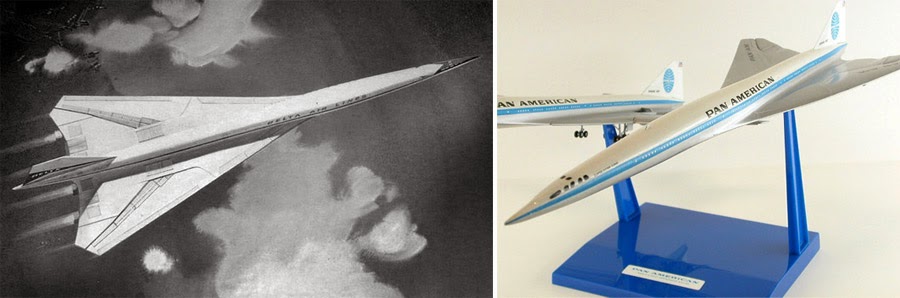
(The Delta Airlines "swing wing" 2707 designs; bottom right model by John Meyer)
Here is the size comparison:
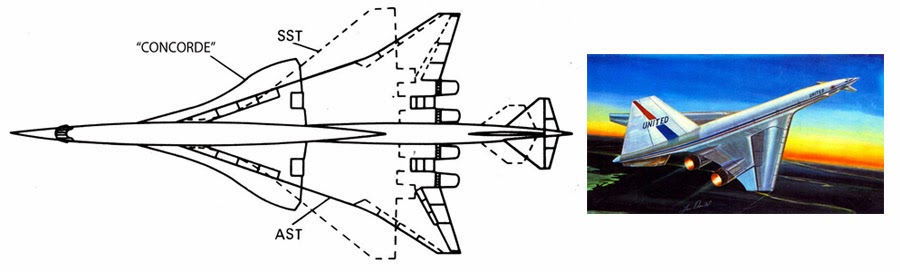
(left image credit: Boeing)
Boeing 2707-300: already 2 years behind schedule... a prototype that never flew.
The new design was now smaller, seating "only" 234. Two prototypes were approved by President Nixon in 1969, as it was a widespread belief that SST aircraft would soon dominate the skies, rendering all other subsonic aircraft obsolete.
Length: 306 ft (1968) 318 ft (1972)
Wingspan: (1968) 174 ft extended 106 ft swept
Cruising speed: Mach 2.7 or 1,800 mph
Weight: (1968) 675,000 lb
Passengers: 300
Altitude: More than 60,000 feet
Power: Four GE4 turbojets
Range: Transpacific, 4,000 mi


(photos courtesy: Ben Wang via Airliners.net)
Soon, however, the all-too-smooth-going project began to gather adverse publicity. The biggest complaint was the environmental "noise pollution" issue, particularly the inevitable sonic booms and a possible reduction of the ozone layer. These concerns (perhaps not surprisingly) gained a lot of weight in the government, with the result being the complete ban on supersonic flights overland in the United States. Another troubling fact was discovered: at speeds above Mach 2.2 the aircraft would encounter so-called "skin friction effect" and its body will have to be built completely from either stainless steel or titanium, significantly increasing the price. The government (dogged on all sides and troubled by the Vietnam war) decided not to spend additional millions of dollars and completely cut the funding in 1971.
According to Wikipedia: "The SST became known as "the airplane that almost ate Seattle." Boeing was a major economic force in the region, and was stretched so thin that a billboard was erected that read, "Will the last person leaving Seattle - turn out the lights?"
"The High-Speed Research (HSR)" program was also canceled by NASA in 1999:

(image credit: NASA)
Extreme costs in operating these glamorous supersonics brought the whole SST idea to an unfortunate end: the beautiful Concorde now resides in a museum, and the skies are dominated by sluggish, but fuel-efficient subsonic jets. The dream remains just a dream, for now... but consider one interesting fact: when government withdrew the funds for SST program, the money (over a million dollars) started pouring in from... American schools & kid's donations. Sadly, children's enthusiasm alone could not save the project.

("Concorde" resides in a museum; appropriately, in Seattle)
By the way, one of the most glamorous flights of the French Concorde was during the full solar eclipse in 1973 - as a flying scientific laboratory. This page has a few more pictures.
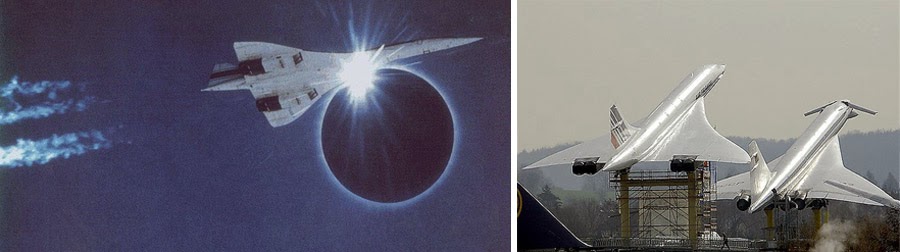
(image credit: NASA)
But it's not the end of the story: meanwhile, in the remote & mysterious Russia... The new and improved TU-444 keeps the dream alive, and then some!
The Soviet Tu-444 was the first commercial SST aircraft flown (built almost entirely on KGB money & Soviet military technology). It was withdrawn after a short time due to crashes and problems (not again!), but not before motivating Europeans and Americans to accelerate their own projects. Today, the Tupolev Aircraft Design Bureau seems determined to keep the project alive and, perhaps one day, we will see these plans result in next-generation Supersonic Transport (which will not be plagued by problems and accidents).


(images credit: Tupolev.ru)
Some say that modern travelers can get anywhere on the planet within 24 hours anyway, so it is kinda pointless trying to improve flight times with expensive SST fleet - but no, people at Tupolev's Design Bureau are apparently still pretty excited by the idea of getting from Moscow to New York - and back! - within a day:

And now, even though the dream itself lives on, the times when governments raced each other to realize a shared dream, are clearly over.
Article by Avi Abrams, Dark Roasted Blend.
Sources and further reading: Tupolev.ru, Hiller Aviation Museum, Testpilot.ru, Boeing, Global Security Military site
CONTINUE TO "FUTURISTIC AIRCRAFT UPDATE" ->
READ THE REST OF "AMAZING AIRPLANES" CATEGORY ->
|
|
RECENT ARTICLES:
"Dark Roasted Blend" - All Kinds of Weird and Wonderful Things, Discovered Daily!"
DRB is a top-ranked and respected source for the best in art, travel and fascinating technology, with a highly eclectic presentation. Our in-depth articles in many categories make DRB a valued online magazine, bringing you quality info and entertainment every time you visit the site - About DRB
Connect with us and become part of DRB on Facebook and Twitter.
YOUR COMMENTS::
READ OTHER RECENT ARTICLES:
CATEGORIES:
Feel-Good! | airplanes | animals | architecture | art | auto | boats | books | cool ads | famous | futurism | food
gadgets | health | japan | internet | link latte | military | music | nature | photo | russia | steampunk
sci-fi & fantasy | signs | space | technology | trains | travel | vintage | weird | abandoned
|
|


























































 |
|







12 Comments:
What an interesting article. Imagine how different things could have been.
These concerns surprisingly gained a lot of weight in the government...
"Surprisingly"..? Have you actually looked at the results of the sonic boom testing done at Oklahoma City in early 1964, and at White Sands later that year? We're not talking fuzzy green Luddite environmentalism here... we're talking what the FAA and Boeing concluded would be millions in payments for physical damages per overland flight.
The article misses the fact that Concorde did indeed fly successfully and accident free for a great many years.
The TU144 was a great triumph both of soviet ingenuity, and soviet espionage, incorporating much of concorde's design.
Whilst a Concorde is in a museum in Seattle it is far from being the only one preserved.
One is at Filton, near Bristol, England, from where the first proving flights took off.
Truth is, Concorde was a triumph that worked, first flying in 1969, in service 1976, and continuing until late 2003. An airliner that flew higher and faster than any other, ever.
Whereas the Boeing SST was a pipedream that never materialised.
The interest of the governments may not have been as benign as the article implies. There is a story that - as a test - they once flew a Concorde out over the Norwegian Sea then had it cruise back over Britain at its normal height and speed, just to see how easy it would be to intercept. The answer was that it wasn't. It flew too high and too fast for anything in the UK to get to it before it had flown right across the country.
The noise problem was BAD. I used to work at Heathrow and many the time I stood outside Hatton Cross (tube) station as Concorde climbed into the sky. There was a longterm carpark between the station and the runway, which meant that Concorde passed over that even lower, and as the rumble of the plane died away you could always hear the blaring of the horns of the cars - their theft alarms triggered by the vibration. I often used to wonder how many travellers parked in there and got back to find that - for some unknown, to them, reason - their car batteries were flat.
Beautiful plane though!
soubriquet said:
"The TU144 was a great triumph both of soviet ingenuity, and soviet espionage, incorporating much of concorde's design."
May be Concordes' design was stolen from USSR? Tu-144 has it's first flight 2 months earlier.
http://en.wikipedia.org/wiki/Tupolev_Tu-144
"However, even if this were to be confirmed, the documents were early development plans and would not have permitted the USSR's engineers to come up with their own aircraft; the plans could only serve as a general indication of the work of the Concorde design team. Moreover, Soviet aircraft designers in the 1960s had significant experience building delta-shaped aircraft, which proved an efficient means of achieving Mach 2, and TsAGI, of which Andrei Tupolev was a graduate, had developed extensive data about such designs."
Learn history, lamer!
It's sad that the Concorde is out of service, and that these airplanes not even got to fly...
Yeah, yeah. I'll believe the US can build a craft comparable to Concorde when I see it build a V/STOL plane that isn't 100% craptacular (especially when compared to my country's brilliant AV-8B Harrier). Until then, forgive me for thinking that you're way out of your league here.
Pfft. It's all about undersea magnetic trains these days.
Dear friends:
I uploaded some pictures of the SST Museum that my father took during our trip to Florida the summer of 1976.
Hope you enjoy them, the link is: http://www.flickr.com/photos/8767849@N07/sets/72157618299890370/
I will be uploading more pictures of the SST Museum soon !!!!!
Kind regards from rainy Mexico City.
Jose Carreno
Thank you Jose - great contribution!
All three programmes became surrounded in myth. The soviet 'steal' question was settled some time ago in a British TV documentary when Boing, Concord and Tu./KGB engineers all got together and reminised, their chat then being intercut throughout the telling of the story by narator/camera.
The ex-Soviets admitted that they had stolen a complete set of plans through the French end of the Concord programe but didn't use much from them as their design was already too advanced (in the process of procurment). The British and French designers looked at Tu blueprints and agreed that there was nothing 'really' Concord about the Tu.
Another story revolves around the fact that the Americans were so pissed off at A) the success of Concord and B) the cancellation of their own that they spent years not letting C. land at New york or other places useing the noise argument.
I lived under the flight path of Concord most my early life and still miss her at 11am most days. The roar of those jets was akin to a Bloodhound Missile, Minutman or small satalite launch-vehicle. It was the sound of mens dreams writ large, and sometime in the 80's under Thatcher, Regan, Schmitt and Miterresturant or whatever his name was...we stopped dreaming, the bean counters and grey suits took final control over our destiny and it's all down-hill now...
Pity they didn't consider the now-booming Asian economy - reducing the miserable trudge over the Pacific would bring in huge profits.
Post a Comment
<< Home